The House Divided Project at Dickinson College and the Gilder Lehrman Institute of American History are doing something unprecedented. They are launching an open,online graduate course called “Understanding Lincoln” that will be taught by noted Lincoln scholar Matthew Pinsker in Summer / Fall 2013 and available for anybody who wants to learn more about Abraham Lincoln and his legacy during the the period leading up to the 150th anniversary of the Gettysburg Address. The limited enrollment graduate section of this unique online seminar which offers a full-semester graduate course credit (3.0 hours certified by transcript from Dickinson College) is designed especially for K-12 educators who want to learn innovative ways to teach Lincoln’s writings within the new Common Core state standards. Registration for graduate students ends on Friday, July 19, 2013 but space is limited and enrollment will close on a first-come, first served basis. The course tuition is $450. The open section of the course is entirely free, however, and offers any lifelong learners a chance to follow along with selected elements of the experience and to receive a Certificate of Completion from Dickinson College if they complete certain key components of the coursework.
Graduate students in the limited enrollment section of the online course will also have a very special opportunity to participate in the events surrounding the 150th anniversary of the Gettysburg Address. On November 19, 2013, selected graduate students from “Understanding Lincoln” will be invited to attend the anniversary commemoration in Gettysburg, Pennsylvania at no cost –including free travel and accommodations. After the morning Dedication Day ceremonies, we will host a live-streaming webcast directly from the historic Wills House in Gettysburg where President Lincoln stayed during the night before he delivered his famous address. Partly through the extraordinary generosity of the Lincoln Leadership Institute, we will then be able to highlight the best multi-media final projects submitted by students in the course. These are the students who will be selected by Prof. Pinsker to attend the ceremonies and present their work in a live online session with fellow students and other interested course observers.
If you’d like to see an example of how this online learning experience works in a history course, please check out this video segment on the Emancipation Proclamation, produced by Gilder Lehrman education coordinator Lance Warren and featuring Prof. Pinsker leading a short, close reading of the January 1, 1863 document. You might be surprised by what you don’t know about this famous executive order and how much can be gained by going through it almost line-by-line.
Additional Course Information
Faculty Profiles
Matthew Pinsker will be the main instructor for “Understanding Lincoln.” Pinsker holds the Brian Pohanka Chair for Civil War History at Dickinson College in Carlisle, Pennsylvania where he also directs the House Divided Project, an innovative effort to create free digital resources on the Civil War Era for K-12 classrooms. Pinsker is the author of various books and articles on Abraham Lincoln, including Lincoln’s Sanctuary (Oxford, 2003) and the forthcoming Boss Lincoln (W.W. Norton). Currently, Pinsker serves as a Visiting Research Professor at the Strategic Studies Institute of the US Army War College in Carlisle, Pennsylvania. He is also a Distinguished Lecturer with the Organization of American Historians (OAH) and a Bernard L. Schwartz Fellow at the New America Foundation in Washington, DC.
Lance Warren will serve as the chief course producer. Warren is Director of Digital Projects for the Gilder Lehrman Institute of American History. He leads Gilder Lehrman’s online education programs and creates original video content for use in K-12 classrooms. His co-directed film, That World is Gone: Race and Displacement in a Southern Town, won the Audience Award for Short Documentary at the 2009 Virginia Film Festival. Warren received a B.A. in History and Political Science from Syracuse University and an M.A. in History from Brandeis University.
Course Description
Nobody would have appreciated the power of open online education more than Abraham Lincoln, one of the great self-made, lifelong learners in world history. This open online graduate history course aspires to create the kind of course that Lincoln would have appreciated. Just about 150 years ago, President Lincoln explained at Gettysburg how he believed that the Civil War would establish what he termed “a new birth of freedom” for the United States. During our sessions in 2013 (July 23-Nov. 19), Professor Matthew Pinsker will use this anniversary moment to share the latest historical insights about Lincoln as well as to introduce participants to a number of cutting-edge digital resources for the study and teaching of Lincoln’s legacy. The course will be organized around five popular designations that have been applied to the great president over the years (Railsplitter, Honest Abe, Father Abraham, Great Emancipator, and Savior of the Union) and will dig deeper into each of these themes in order to help explore their origins and assess their validity. In the process, participants will come to better understand Lincoln as man and president, and will also enjoy a unique online platform to share their own insights.
Course Objective
Crowd-sourcing is a phrase used to describe how individuals can help develop online projects by contributing content to them remotely. Through the “Understanding Lincoln” course, we will attempt an experiment in what might be called “class-sourcing.” Participants in this course will have the opportunity to develop various types of content that will be published online as part of a forthcoming multi-media edition of Lincoln’s selected writings. The very best work by course participants will then be featured during a Livestreaming field trip to Gettysburg on November 19, 2013 –the date which marks the 150th anniversary of the Gettysburg Address. We will webcast that day from the historic Wills House where Lincoln slept the night before delivering his famous remarks. Three seminar participants whose work has been judged the best in the course will then be invited to participate in the November 19 events at no cost to themselves –with travel and lodging costs paid for by the course sponsors.
Course Readings
All readings for this course will be freely available online. Beyond intensive readings of Lincoln’s own letters, speeches and personal documents, participants will also have assigned essays and articles to read from leading historians such as David Blight, Michael Burlingame, Eric Foner, Mark Neely, James Oakes, and Sean Wilentz.
Course Assignments
Graded assignments for this course will include various types of online discussion and written participation as well as a series of short writing assignments, including blogging. The culmination of the course will involve the production of a major multi-media teaching project with an accompanying research paper that describes the project’s pedagogical intentions. The final multi-media projects will employ at least one of the digital tools introduced during the course utilized in a way that helps teach Lincoln’s legacy in a creative fashion by presenting various documents and writings from his contemporaries.
Course Schedule
Dates and times for particular course sessions remain subject to change, but here is a tentative list of key course events:
Friday, July 19 Registration closes
Tuesday, July 23 Seminar Introduction (7-9pm EST)
Thursday, August 1 Discussion section (7-9pm EST)
Wednesday, August 7 Seminar –Lincoln the Railsplitter (7-9pm EST)
Wednesday, August 14 Discussion section (7-9pm EST)
Wednesday, August 21 Seminar –Honest Abe (7-9pm EST)
Wednesday, August 28 Seminar –Father Abraham (7-9pm EST)
Tuesday, September 3 Seminar –Great Emancipator (7-9pm EST)
Tuesday, September 10 Seminar –Savior of the Union (7-9pm EST)
Tuesday, October 15 Final multi-media projects due
Tuesday, November 19 Virtual Field trip –Gettysburg Address with special participant presentations (Time TBA)
Sunday, December 15 Final grades posted
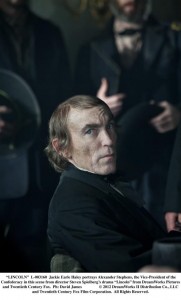 One of the several critical strands in the “Lincoln” movie concerns the controversy surrounding the Hampton Roads peace talks (February 3, 1865), where President Lincoln and Secretary of State Seward met with Confederate envoys Alexander Stephens, John Campbell and Robert M.T. Hunter for secret discussions about how to end the war on board the River Queen in Union-controlled Hampton Roads, Virginia (near Fortress Monroe). No transcript exists for their conversations that day. Lincoln and Seward died before leaving any recollection of the affair. So historians have mostly relied upon on the dubious
  According to the “Lincoln” movie script, Friday, January 27, 1865 was an action-packed and pivotal day. It was the day of Thaddeus Stevens’s controlled performance in the House, declaring himself strictly for “equality before the law.” It was also the day marked by Abraham Lincoln’s bitter argument with his oldest son Robert and then his subsequent clash with his wife Mary after he finally decided to concede to Robert’s desire to join the Union army. And it was in the evening of the 27th that both Mary Lincoln and later dressmaker Elizabeth Keckley urged the president to abandon his hidden-hand approach and provide more decisive leadership in the fight for the antislavery amendment. All of those “events” are fictional, but they are essential for understanding the film’s point-of-view –namely, that Lincoln interjected himself at the end of the battle for the constitutional amendment in a way that proved decisive.
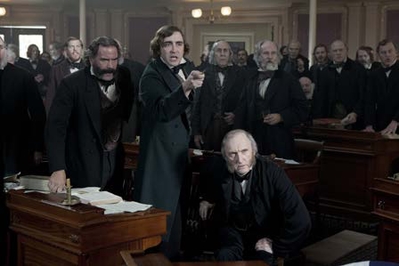 The filmmakers present this exchange in the most dramatic fashion possible, having Democratic leader Fernando Wood (D, NY) first disrupt the proceedings, allegedly waving “affidavits from loyal citizens” confirming the existence of secret peace talks. This creates chaos on the floor of the House that leads a fictional “conservative” Republican named Aaron Haddam to indicate (after receiving a critical nod from Preston Blair, perched in the gallery) that the “conservative faction of border and western Republicans” could not support an amendment “if a peace offer is being held hostage to its success.” Then there is a mad footrace from the Capitol to the White House, involving Lincoln’s aides and the Seward lobbyists. John Hay, the president’s young assistant private secretary, heatedly warns him against “making false representation” but Lincoln crafts his reply (technically true but obviously deceptive –since the commissioners were on their way to Hampton Roads, VA) and hands the note to seasoned lobbyist William N. Bilbo (James Spader). Bilbo then delivers it to Rep. Ashley who reads it with a flourish to the entire House. There is no record of any of this in the official proceedings. Nor does Ashley claim in his recollection that he read the note from the president on the House floor. Instead, it seems he may have simply showed it to some key figures. Bilbo was not even in Washington at the time (see previous post
 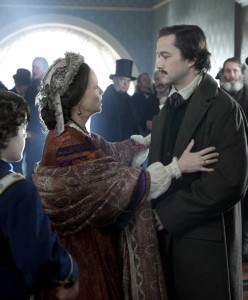 No single film could ever hope to capture the range of historical interpretations that have been offered to explain the complicated Lincoln family dynamics. Some historians consider the marriage between Abraham and Mary Lincoln to have been “a fountain of misery.” Others see longstanding affection and partnership. Some find Lincoln to have been essentially an absentee father. Others extol his sensitive parenting toward very different sons. And these debates have proven especially difficult to resolve because the evidence is so thin. Hardly any of the family correspondence remains. None of the family members kept diaries. Almost all of our information about their relationship derives from second- or third-hand accounts, usually recollected after the war.
 Nor is there any basis in the historical record for intertwining the story of Robert Lincoln’s late entry into the Union army with his father’s increasingly determined efforts to secure passage of the antislavery amendment. Yet in one of the movie’s more audacious –and improbable– plot twists, scriptwriter Tony Kushner follows the explosive back-to-back family arguments of Scenes 29 and 30 with a revealing trip to the opera that suddenly provides a personal motivation for Lincoln’s new sense of urgency about the amendment’s passage. The script identifies the opera as Gounod’s “Faust” at the Odd Fellows Hall with the president, his wife and Elizabeth Keckley in attendance. In reality, the Lincolns had seen this popular opera with William Seward when it was showing at Grover’s Theater during the previous month, in
 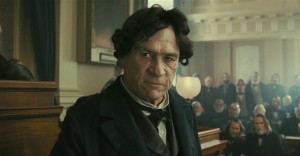 In the scene in Spielberg’s “Lincoln” which introduces the audience to Rep.
  Smith
Smith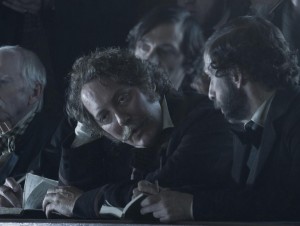 Although “Lincoln” is a serious movie with a high moral purpose, there is still a great deal of comic relief provided mostly by an amusing trio of corrupt lobbyists. What students might find confusing about these figures, however, is that despite the fact that they were “real” men, the movie either totally invents or sometimes just thoroughly rearranges their actual activities.
  The main narrative of Steven Spielberg’s “Lincoln” movie opens with a dream that
 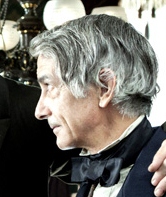 Consider this incongruity: in the movie, Seward (David Strathairn) asks Lincoln, “since when has our party unanimously supported anything?” and yet the correct historical answer to that question is simply the last time the abolition amendment appeared in the House (June 1864) when the ONLY Republican to vote against it was Rep. James Ashley, the sponsor, who did so on technical grounds so that he could bring it back later for reconsideration. By the end of the war, Republicans supported the abolition of slavery –it was a central plank of their party platform in the 1864 election and part of the basis for their landslide victories in November. Border states such as Maryland and Missouri were already in the process of abolishing slavery on their own –with full Republican support. Montgomery Blair had been “pushed out” of the president’s cabinet in September 1864 as part of a deal with radicals –as the movie suggests– but Preston Blair (Hal Holbrook) surely never told Lincoln, as he does in the film: “We can’t tell our people they can vote yes on abolishing slavery unless at the same time we can tell ‘em that you’re seeking a negotiated peace.” It’s not even entirely clear that the elderly and highly controversial Blair had any “people” left in the House now that his other son Frank (Francis Preston Blair, Jr.), a former congressman, was back in the Union army.