This student essay was written in summer 2019 just before the release of the Dickinson & Slavery report.
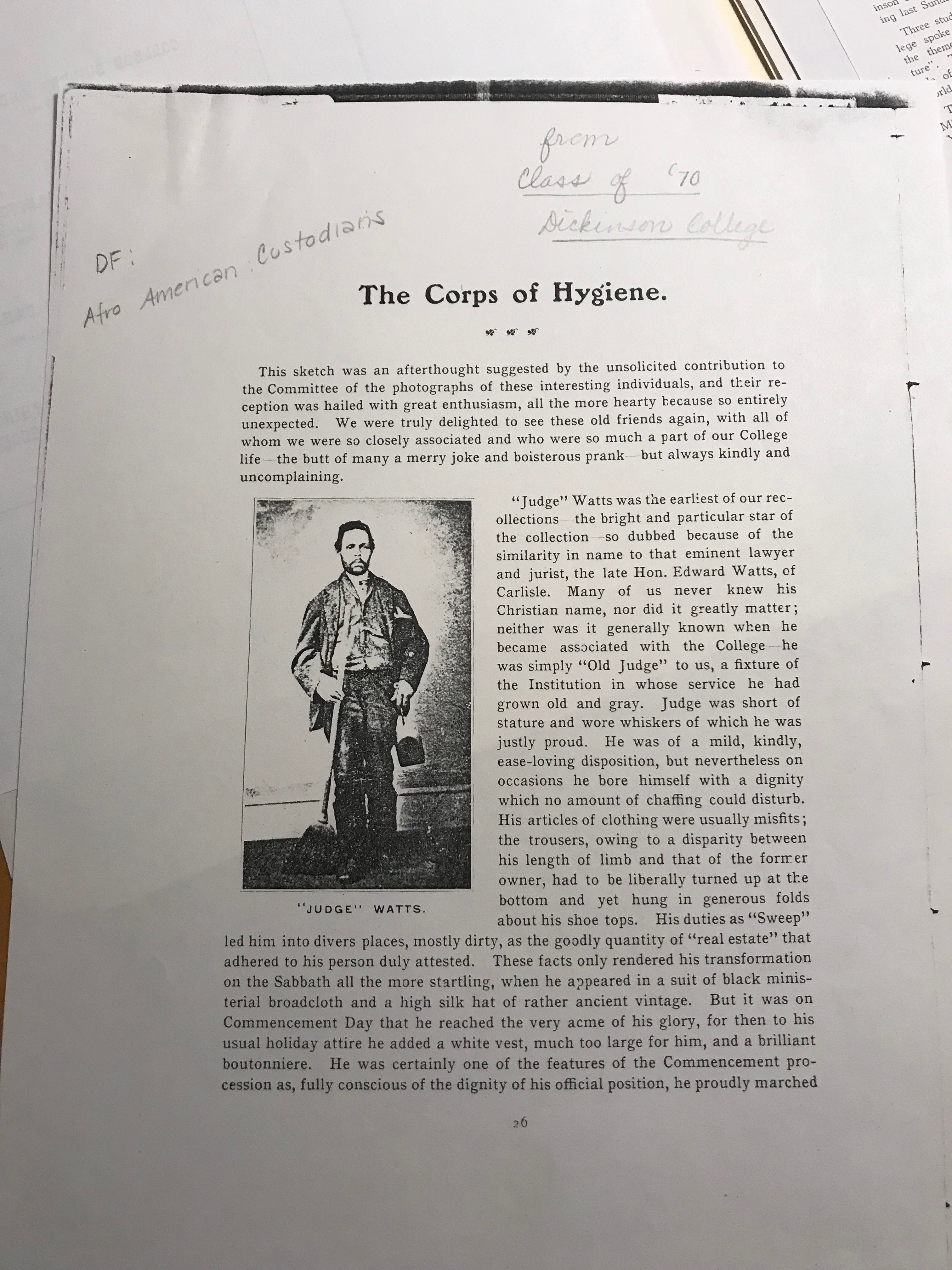
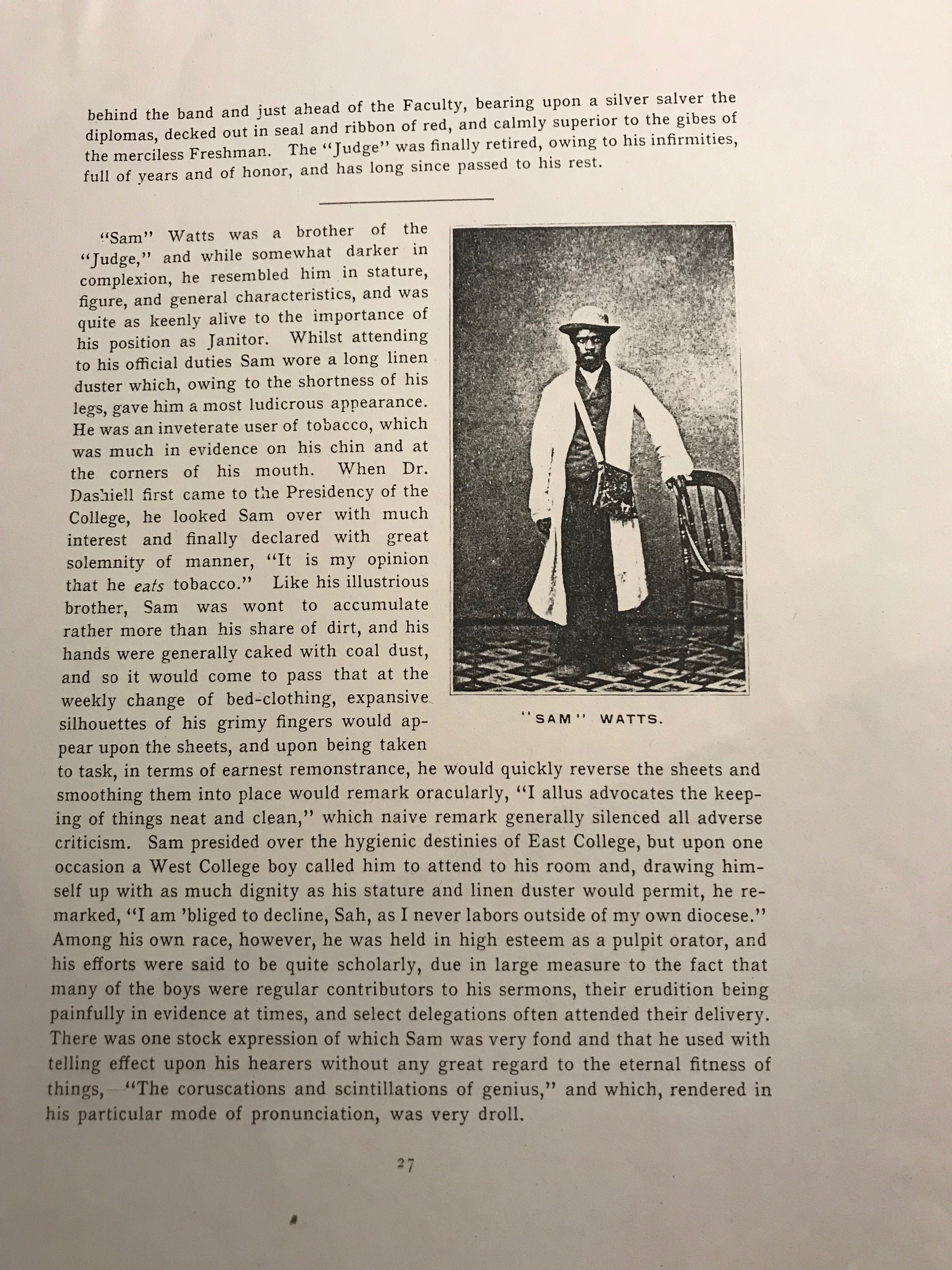
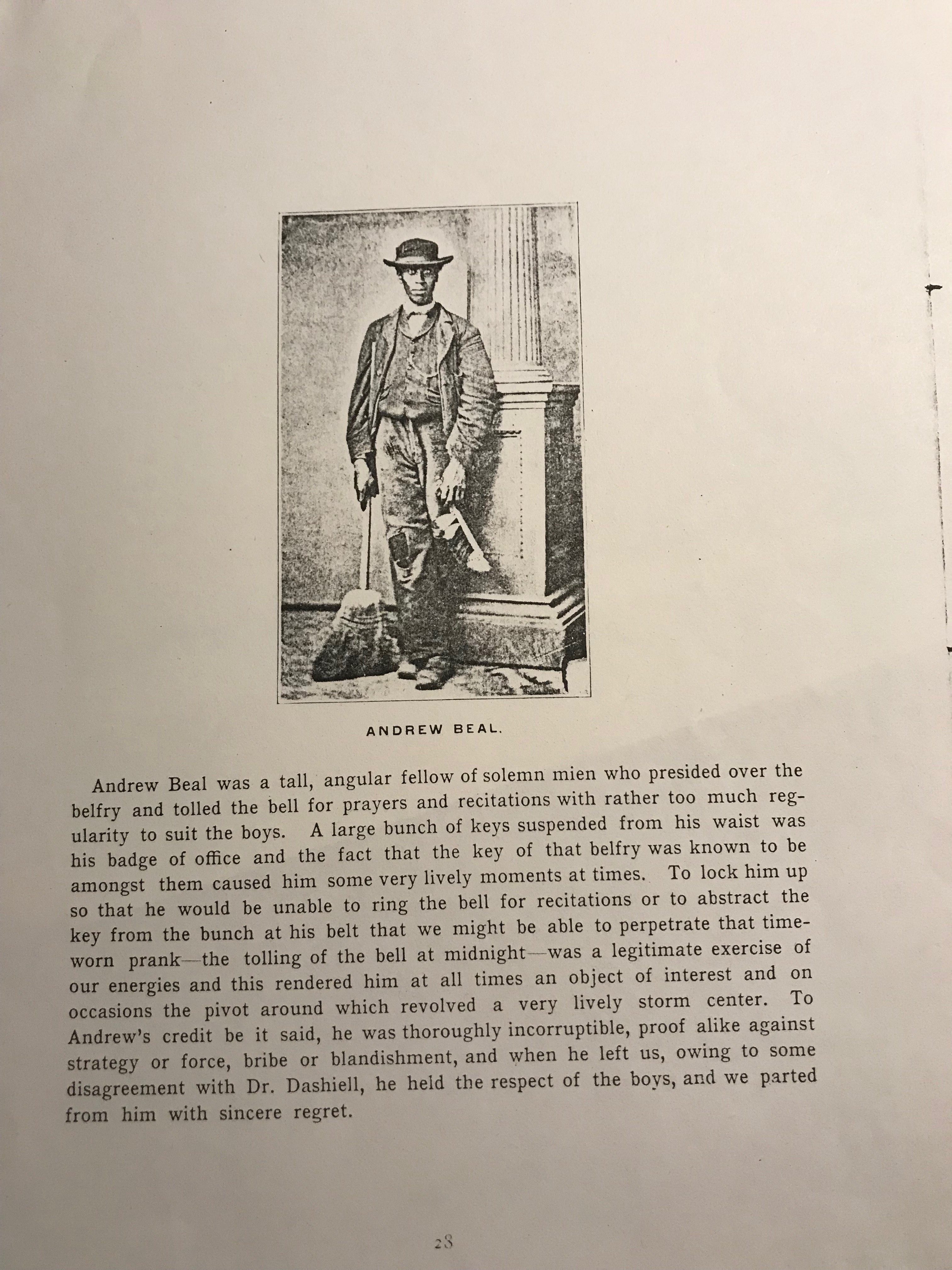
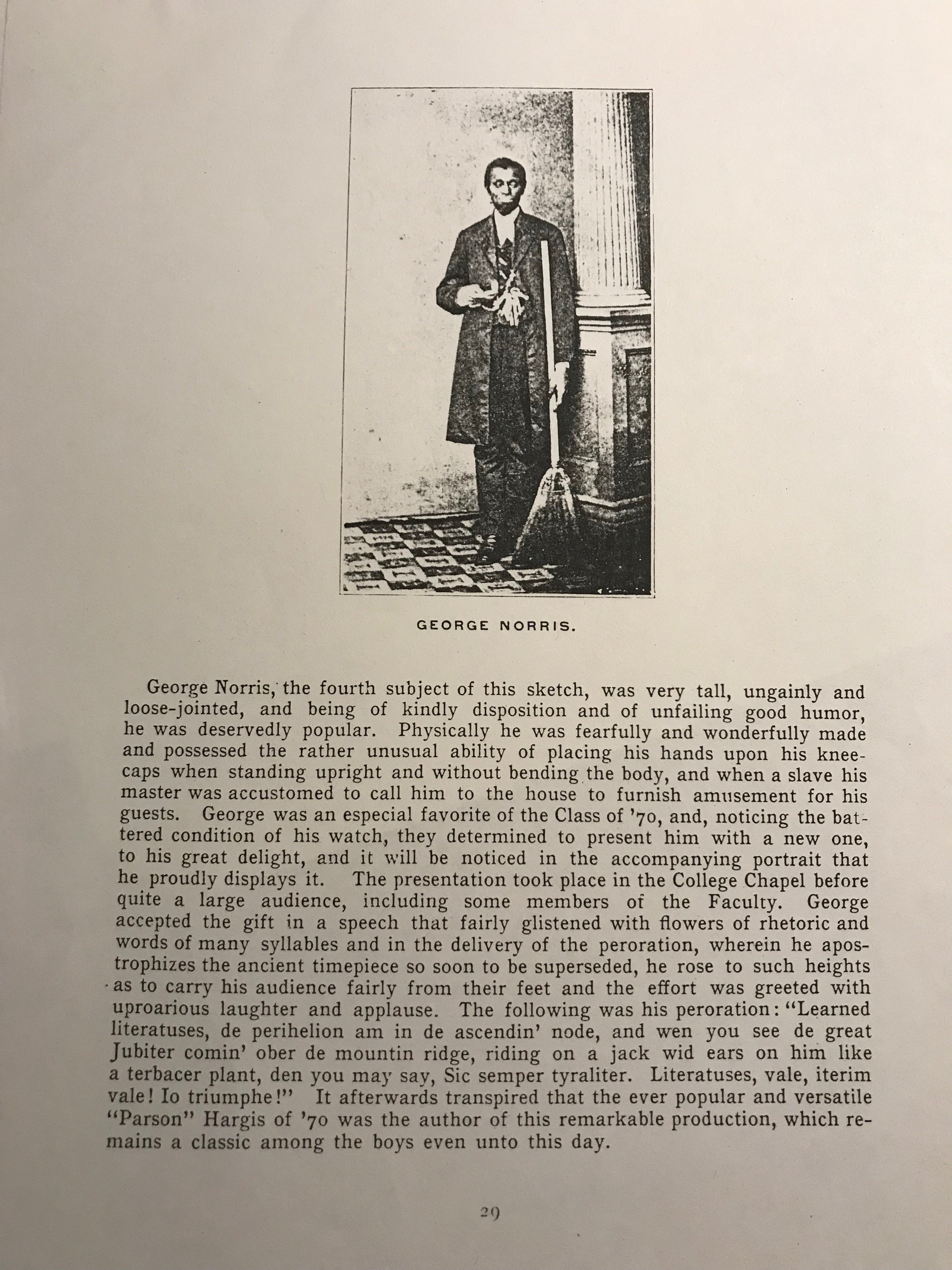
In the late 19th Century, students at Dickinson College inevitably crossed paths with the college’s African-American employees. Some were former slaves and Civil War veterans, but nearly all were fixtures of campus life. Janitors brought firewood to students’ rooms, maintained the buildings and interacted with students on a daily basis. Henry Spradley, one such janitor, was known as “the king of West College [Old West].”[1] Then there was Noah Pinkney, known as “Uncle Noah,” who–though not a college employee–sold ice cream and oysters outside of the East College gate for years. It was only partly in jest that an 1899 edition of the Microcosm included on a list of places “Students Should Visit,” in bolded, large letters, the name “Pinkney.” [2] Students returning decades later as alumni fondly remembered these familiar faces as “old friends.” [3]
Yet beneath these benign recollections lay a more nuanced reality. Far from full members of the campus community, African-American janitors were excluded from spaces reserved—both expressly and tacitly—for whites. In their attempts to break through these barriers, janitors repeatedly became the subjects of controversy and exclusion.
In 1886, the family of janitor Robert Young received a cruel reminder of their secondary status. Young’s son, a recent graduate of Carlisle High School, applied to attend Dickinson’s preparatory school, igniting a firestorm that briefly paralyzed the Dickinson community. News reports generally attributed the threats to the college’s “southern young bloods,” who made up a substantial block of the student body. “The audacity of the son of the colored janitor in seeking admission seems to have maddened them.” noted the Philadelphia North American. Yet as one Ohio paper reminded its readers, this was nothing new: “Dickinson college is nothing if not notorious.” Only a few years had passed, penned the editor, “since a colored janitor was hung to a beam in one of the rooms of the college, raised and lowered repeatedly and at last driven out of Carlisle, all to extort a confession from him of a theft of which a senior was subsequently convicted.” [4] The Young family was confronted with a whirlwind of procedural delays, threats and intimations of violence. Outlasting the backlash, Young was finally admitted. [5]
On more than one occasion, students and faculty wrongfully accused African-American employees and their families of thefts. There was the notorious incident years earlier, referenced by the Ohio editor, in which students held a simulated lynching of a janitor for a theft actually committed by a student. Then in 1892, longtime janitor Henry Spradley’s son, Shirley, was arrested under the pretense of stealing $40 in cash from a student’s trunk, though he was promptly exonerated. [6]
In the eyes of white society at least, the latter incident was forgotten four years later when Shirley Spradley was engaged to be married. Around 100 students—“armed with cow bells and the musical instruments”—marched to his house, assembling outside as the younger Spradley gave a speech, thanking the student body for “celebrating each big victory.” Perhaps more revealing are the remarks of the elder Spradley, who emerged to tell the students that “he had never made much of a speciality of physiology, [psychology], or many of the other ologies but that he had put in a good many years at bellology and that he would get back at them the next morning at chapel time.” As he spoke, students interrupted with “several fog horns and a multitude of cat calls,” signifying if not outright disrespect, then amusement and novelty at Spradley assuming the role of public speaker. The same report included a reference to Spradley as “‘Prof.’ Henry Spradley,” (a joke repeated in the Microcosm)—the humor lying in the improbability of Spradley, a black man and janitor, ever assuming a position reserved almost exclusively for well-educated white males. [7] Indeed, a group of student reminiscences from the period acknowledged that the college’s janitors “were so much a part of our College life–the butt of many a merry joke and boisterous prank–but always kindly and uncomplaining.” [8]
Hostility towards the college’s black employees also followed similar racial anxieties prevalent in the 19th Century North. Many working-class whites in Carlisle feared competition from African-Americans, both before and after the Civil War, as evidenced in an anonymous 1842 letter addressed to Dickinson’s president. A correspondent signing himself “A Friend of Dickinson College and the rites of Man,” demanded to know why “must nearly all the minor work of the installation be given to colored people.” He groused that “not even a native negrow [sic] of this state is imployed [sic] in the college,” but instead those “who neather [sic] contribute by tax nor influence to publick institutions” and “usurp the rites [sic] of the sober industri[ou]s white man.” [9]
There is no doubt that Dickinson students had affection for their janitors, but it was affection on their terms. The humorous anecdotes they recorded were often tinged with racism. When janitors or their families attempted to integrate into exclusively white spaces, the swift reaction they often met with served as a stark reminder of the racial prejudices of the day.
Notes
[1] “There He Goes,” The Dickinsonian, March 1883, vol. 10, no. 6, Dickinson College Archives & Special Collections, quoted in Rebecca Stout, “Henry W. Spradley,” Dickinson Employees Exhibit, [WEB].
[2] “Students Should Visit,” Microcosm, 1899, Dickinson College Archives & Special Collections.
[3] “The Corps of Hygiene,” Microcosm, 1903, 26-27, Dickinson College Archives & Special Collections.
[4] “A Humiliating Confession,” Philadelphia North American, October 26, 1886; Springfield Daily Republican, October 31, 1886.
[5] “The Color Line in College,” Boston Herald, November 22, 1886.
[6] Harrisburg Patriot, December 21, December 22, 1892.
[7] “Spradley-Caldwell Nuptials,” Carlisle Sentinel, April 30, 1896.
[8] “The Corps of Hygiene,” Microcosm, 26-28.
[9] Anonymous Correspondent to Robert Emory, September 23, 1842, Box 1, Series 1, RG 2/2 Presidential Papers, Dickinson College Archives & Special Collections; Brian Luskey, “Houses Divided: The Cultural Economy of Emancipation in the Civil War North,” Journal of the Early Republic 36, no. 4 (2016):637-657.








 For this post, I have assembled available digitized primary sources from the