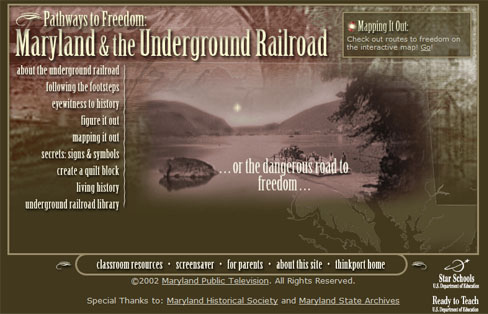
I found a lesson plan to go with the interactive map of the Lincoln Douglas Debates interactive map I found yesterday! Find more lesson plans at the House Divided’s Underground Railroad Digital Classroom.
20
Jun
I found a lesson plan to go with the interactive map of the Lincoln Douglas Debates interactive map I found yesterday! Find more lesson plans at the House Divided’s Underground Railroad Digital Classroom.
20
Jun
PBS has made a film exploring the illustrious and radical abolitionist John Brown. Called “John Brown’s Holy War,” the film explores John Brown’s life and crusade for abolition of slavery, asking if the man was “…a martyr or a madman, a fanatic or a hero…”. PBS provides a webpage advertising the film and also giving an overview of John Brown’s life, including time lines and an interactive map. A teacher’s guide is also included.
20
Jun
Knox College’s Lincoln Studies Center has created a podcast series featuring Lincoln scholars and co-directors of the center Rodney Davis and Douglas Wilson. The podcasts give a brief overview of each debate and then commentary and analysis. The podcasts are each no longer than ten minutes in length. Good content for middle school and high school study of the Debates.
Douglas Wilson’s Lincoln’s Sword won 2007′s Lincoln Prize. The book explores the power of Lincoln’s writing and his development as a writer by exploring notes, drafts, and speeches written by the president. The House Divided Project provided copies of this book to teachers attending its June 13th teacher’s workshop at Dickinson College.
19
Jun
Before the Supreme Court announces a decision in important cases, newspapers often try to predict the verdict. This also occurred in the 19th Century and some history students might be interested to see what editors said before the Dred Scott decision was announced after President James Buchanan’s inauguration in March 1857. Two months earlier the Washington Union explained that the Supreme Court had already reached “a decision” that held “the law of 1820 to be unconstitutional.” In addition, the article also accurately noted that northern Justice Robert Grier would approve such a verdict. Some students might be interested to see how the Washington Union’s prediction compared to the Supreme Court’s actual decision.
19
Jun
I found an interactive map of the Lincoln-Douglas Campaign of 1858.
The Underground Classroom’s Virtual Field Trips also offers an interactive map of the Lincoln-Douglas Debates using Google Earth. Visual maps are a useful tool to demonstrate and analyze the significance of the Lincoln-Douglas debates. The maps are a perfect tool for your students to use during the 150th anniversary of the Lincoln-Douglas debates.
18
Jun
One interesting aspect of John Brown’s attack on Harpers Ferry in October 1859 was the lack of a uniform response in the South. Even though Brown hoped to destroy slavery with his raid in western Virginia, southerners had a variety of responses. Many southern newspapers published articles in late October 1859 that held Republicans responsible for the violent event. These editors also portrayed the Republican party doctrine as responsible for pushing radicals like Brown and his men to attack the South. The attack and allegations of Republican support only reinforced southerners’ perspective that members of that sectional party were dangerous abolitionists who were committed to the destruction of slavery.
Yet while some southern editors predicted an increase in sectional tensions, others saw hope for the United States’ future. On November 3, 1859, the Fayetteville Observer published an excerpt from a Republican editor who expressed outrage over Brown’s actions and argued that his party “[would] return to a more national and conservative policy.” Other southern papers glossed over the factions that existed within the Republican party, but the Observer’s editor was one to highlight that not all Republicans supported violent actions. ” With “conservative Republicans cutting loose from the ultra fragments of their party,” the Observer believed “to bring the best of all good out of the late evil at Harper’s Ferry.” Radical Republicans were only “fragments” and their views did not represent those of all members in the party. While this optimistic perspective did not last, it reveals that even two weeks after the Harpers Ferry raid, not all southerners were convinced that an increase in sectional tensions were inevitable.
18
Jun
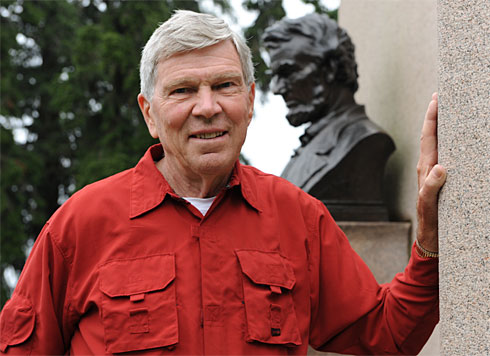
At the recent unveiling of the House Divided project, held June 13th at Dickinson College, Pullitzer prize-winning author and Civil War historian Mark Neely spoke on party politics during the 1850s. He also allowed us a brief interview, during which time we were able to get his impression on Sherman’s March to the Sea and its implication as an example of ‘total war.’ While Professor Neely does not agree that the March was ‘total war’ in a modern sense, Sherman used some of the fiercest tactics yet seen during the war. Indeed, Sherman hoped to have the South “…begging for mercy…” at the conclusion of his march.
This History Channel website provides an interactive map, complete with audio and images, detailing the three campaigns of Sherman’s march. Principal battles of the campaigns and other events are explained, and factoid boxes provide information on little known tactics, events or other interesting things about the March to the Sea.
An interesting, thoroughly 21st century tech exploration of this crucial military movement.
18
Jun
The University of Houston has created a “Digital History” website. There are lots of nice features such as lesson plans and student resources, as well as many experts from textbooks. The site also features digital “eXplorations” which allows students to have a more interactive approach in research. Here is a great example of such site titled, John Brown: Hero or Terrorist
18
Jun
Illinois During the Civil War database has a Teacher’s Tent that has a few lesson plans specifically on the legality of slavery. These lesson plans include standards, but I believe they’re only Illinois state standards.
The Underground Railroad Digital Classroom also provides lesson plans for several levels and also includes standards.
12
Jun
I was reading Mark Neely’s The Boundaries of American Political Culture in the Civil War Era and thought the first chapter had a very interesting story that can be used to provoke discussion among students about politics of the 1864 presidential election in comparison to the politics of the 2008 presidential election.
Neely tells the story of Walt Whitman and his return from Washington D.C. to Brooklyn in order to vote. While at a bar, he noticed the barmaid wearing a McClellan pin. He asked the girl about the pin and she said that all the barmaids who worked at this bar supported McClellan and those that didn’t were not tolerated. Whitman describes how this was “one of those places where the air is full of scent of low thievery, foul play, & prostitution gangrened”*–not a place one would expect much political involvement. Neely uses this anecdote to introduce his point about the high level of involvement of the general public in politics during the Civil War Era.
Some points to take away in order to lead a discussion among students include the fact that barmaids would be so involved in politics when they did not have the right to vote and how that reflects the prevalence of politics on all levels of society. How does this compare to the current election?
There are several points made just even in this first chapter that present a range of ideas and points that can easily create a discussion among students. Neely will be presenting at the House Divided workshop on Friday, June 13 on the Politics of the 1850′s. Look on A House Divided YouTube Channel for an interview of Neely from this workshop.
*Mark E. Neely Jr., The Boundaries of American Political Culture in the Civil War Era (Chapel Hill:The University of North Carolina Press, 2005), 2.