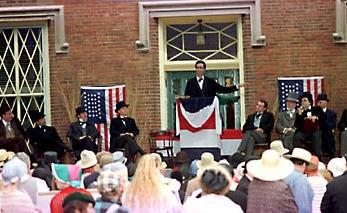
 With Lincoln Productions combines the acting talents of Michael Krebs and Debra Ann Miller to recreate moments in the life of Abraham and Mary Todd Lincoln. The group has performed for the History Channel, news casts, schools, and special events; however, its most popular reenactment remains the “Lincoln Douglas Debates from 1858,” a series sponsored by C-Span. Located on the With Lincoln Productions’ page is a section highlighting the Galesburg Debate reenactment with several short clips from the three hour event. Although filmed in 1994, the video represents the most realistic interpretation of Lincoln as he would have appeared in 1858. Also, the debate itself offers thorough orations from both Lincoln and Douglas as this reenactment follows the three hour format established by the two politicians. As an added bonus, the site houses a link to the C-Span video library where you can watch a full version of the debate on flash (you may need to update your flash player), or you may simply purchase the DVD. This is another great site for those of us looking to learn more about the debates.
18
Jun
09
Civil War Podcast Tours
Published in Civil War (1861-1865), Places to Visit, Video Themes: Battles & SoldiersCivil War Traveler offers audio tours given by National Park Service historians. These tours can be accessed directly through the site or via a free subscription in iTunes. Each podcast episode follows a histo rian as he walks along a famous Civil War battlefield or location such as Antietam or the Appomattox Court House. Since they record each episode live at the battlefield as the historian walks the site, you can download these audio files to a portable music device and use them as your own personal guide at each historic site. The website also has downloadable maps of each historic location in pdf form to help you stay in sync with your guide. This site would be great for bolstering field trips or for teachers who enjoy using their imagination. Students can listen to the tour and follow the guide’s route on the map for a rather engaging experience.
9
Jun
09
Abe Lincoln in the 21st Century
Published in 19th Century (1840-1880), Images, Recent News, Video Themes: Education & Culture The digital revolution is transforming both historical scholarship and the way we view our history. A great example of how new technology is transforming the past comes with the 21st Century Abe website. Presented by the Rosenbach Museum and Library, 21st Century Abe is a collection of photos, pictures, videos, articles, and essays that explore Lincoln’s legacy in a 21st century context. Lincoln related contents ranges from user submitted original art works to an enchanced viewer of original documents, with many different items in between. 21st Century Abe allows users to share and find Lincoln in every 21st century medium imaginable, from scholarship, to art, to even popular culture.
8
Jun
09
Lincoln-Douglas Debates for Kids
Published in Antebellum (1840-1861), Video Themes: Contests & Elections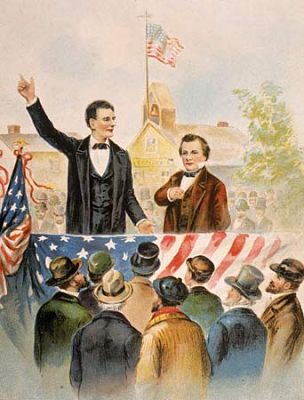
While researching the historic Lincoln-Douglas debates of 1858, I uncovered a video on YouTube that would great for teaching younger audiences about the debates. “The Lincoln Douglas Debates” condenses an overview of the 1858 debates into a simple format designed to keep children engaged. The video’s runtime reaches only two minutes, fourteen seconds and uses both voice-over acting and background music to catch and maintain the audience’s attention. I recommend this site for anyone who wishes to gain a basic background of the debates through a simplistic and entertaining format.
3
Jun
09
Interested in myths about Harriet Tubman?
Published in 19th Century (1840-1880), Video Themes: Slavery & Abolition In an interview available on House Divided’s YouTube channel, Kate Larson explains several myths surrounding the famous Underground Railroad conductor, Harriet Tubman. “The most important ones to talk about,” she explains “is the myth about returning to the south nineteen times and rescuing 300 people.” She further expounds that these myths developed from an early Tubman biography by Sarah Bradford. If interested in following the development of such a myth, Bradford’s book, “Harriet, the Moses of Her People,” is available at the ever expanding Google Books, a great place resource for early Tubman historiography and myths.
5
May
09
Michael Burlingame Talk
Published in Civil War (1861-1865), Recent Scholarship, Video Themes: Contests & Elections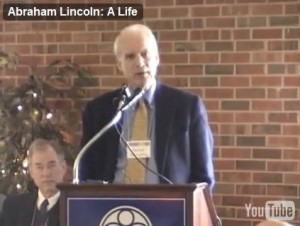 Late last year, Michael Burlingame published a two volume collection titled Abraham Lincoln: A Life. Civil War Memory, another Civil War era focused blog, has a post relating to this publication and Mr. Burlingame himself. More importantly, the post contains a great video (separated into Part 1, Part 2, Part 3, and Part 4) of Mr. Burlingame speaking at Illinois College. For anyone who has used the book in a class or is interested in his work, I think watching this video would be of great value.
18
Apr
09
Preserving the Civil War
Published in Civil War (1861-1865), General Opinion, Places to Visit, Rare Books, Recent News, Video Themes: Battles & SoldiersWhen it comes to history, preserving it is as important as learning it.
Preserving the hallowed grounds of the Civil War is the mission of the Civil War Preservation Trust. The mission of this non-profit organization is “the preservation of our nation’s endangered Civil War battlefields” and to promote “educational programs and heritage tourism initiatives to inform the public of the war’s history and the fundamental conflicts that sparked it.” 
Not only does the Trust’s website explain the group and its mission, it also has a number of useful tools and pages. This includes an extensive collection of videos of various battlefields, an interactive library of Civil War books, and a classroom and history center. It is clearly evident that the Civil War Preservation Trust is doing great things to preserve and teach this important era in our nation’s past. �
13
Apr
09
Open Yale Courses – Professor David Blight
Published in 19th Century (1840-1880), Lesson Plans, Video Themes: Education & Culture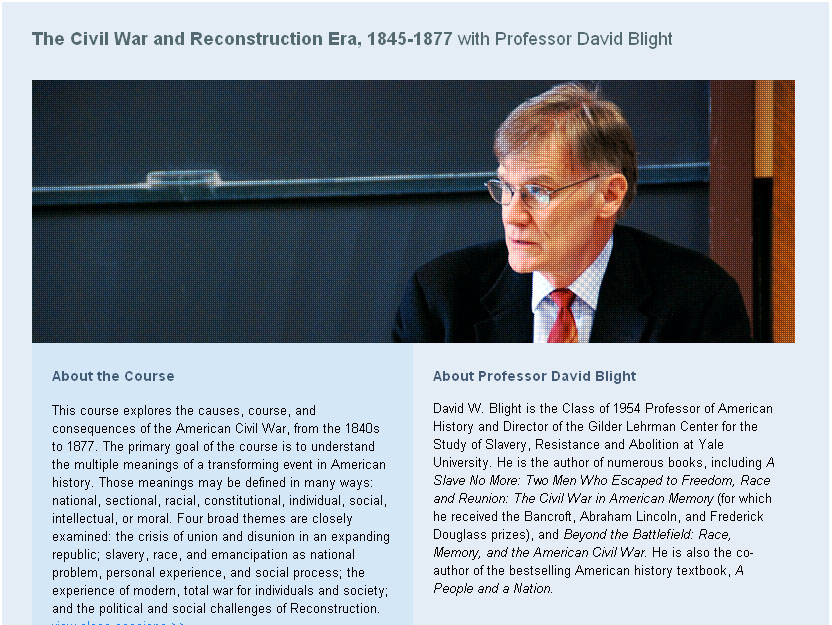
Open Yale Courses is a great online resource that teachers should check out. This project provides free access to courses on a variety of subjects, including Professor David Blight’s HIST 119: The Civil War and Reconstruction Era, 1845-1877. This is not simply a single lecture. Instead, you can listen or watch all twenty seven classes. Transcripts of each lecture are also available.
Only two other history courses are available – France Since 1871 and Introduction to Ancient Greek History.
11
Feb
09
Lincoln Bicentennial National Teach-In
Published in 19th Century (1840-1880), Recent News, Video Themes: Education & Culture Don’t miss the Lincoln Bicentennial National Teach-In on February 12, 2009 at 1:30pm (EST).
House Divided co-director and Dickinson College Professor Matthew Pinsker, Lincoln Bicentennial co-chair Harold Holzer, and Doris Kearns Goodwin (Team of Rivals) will discuss the life and legacy of Abraham Lincoln during a live webcast available at this site: http://www.history.com/lincoln
The Lincoln Bicentennial Commission has more information about this event and the participants.
Two questions to consider before the webcast –
What can we learn from Lincoln?
What should we be doing to honor his 200th birthday?


