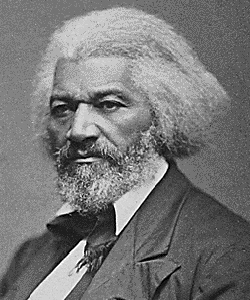
 On Tuesday, January 26, 2010, I am beginning my Civil War Era history class with a quotation from Frederick Douglas at the top of my syllabus. “I shall never forget the difference,” the great activist claimed in 1894, “between those who fought for liberty and those who fought for slavery; between those who fought to save the Republic and those who fought to destroy it.” After surviving and escaping from slavery and after rising to become one of the nation’s great orators and moral visionaries, Douglass certainly earned the right to judge. But the question is … have I? Should a Civil War history professor lead off a syllabus and a semester with a comment like that one, which threatens to shatter the climate of historical objectivity and push students into making moral judgments about who was right or wrong during the Civil War era. Must they learn to condemn slavery and slaveholders, racism and racists –and most importantly, according to Douglass, treason and traitors– in order for the class to be a success? Or is it my job to encourage understanding about all sides in the conflict, regardless of how evil, cruel or stupid they might have been? I do believe in truth, but I also realize how dangerous it can be to turn historical study into an ersatz trial. My inclination is to accept an observation made several years ago by historian John Mack Faragher in the New York Times. “History is ultimately a moral art,” he told a reporter, “and it is about values. It is not merely about the collection of facts. It is about the way we put those facts together and the meaning we give them. Arguments about facts are arguments about meaning.” In other words, bring on the debate –as long as it comes rooted in evidence. But I wonder if students are really comfortable with that view or even know how to navigate historical texts and context while simultaneously arguing over values. Is it all too much, too soon? Has anyone had a classroom experience in any historical subject, but especially perhaps in the Civil War era, that might offer an answer, either as a model or as a warning?
11
Jan
10
"WalMart and the Civil War"
Published in Civil War (1861-1865), General Opinion, Video Themes: Battles & Soldiers
Ta-Nehisi Coates, a contributing editor at the Atlantic, has an interesting essay on “the war between [battlefield] preservation and commerce.” This essay focuses on the Battle of the Wilderness in Virginia and the controversy over Wal-Mart’s plan to build a store at a key location. In addition, check out the author’s video tour of this battlefield and an interview with historian Frank Smith on the significance of African American soldiers during the Civil War.
18
Apr
09
Preserving the Civil War
Published in Civil War (1861-1865), General Opinion, Places to Visit, Rare Books, Recent News, Video Themes: Battles & SoldiersWhen it comes to history, preserving it is as important as learning it.
Preserving the hallowed grounds of the Civil War is the mission of the Civil War Preservation Trust. The mission of this non-profit organization is “the preservation of our nation’s endangered Civil War battlefields” and to promote “educational programs and heritage tourism initiatives to inform the public of the war’s history and the fundamental conflicts that sparked it.” 
Not only does the Trust’s website explain the group and its mission, it also has a number of useful tools and pages. This includes an extensive collection of videos of various battlefields, an interactive library of Civil War books, and a classroom and history center. It is clearly evident that the Civil War Preservation Trust is doing great things to preserve and teach this important era in our nation’s past. �
19
Nov
08
Was Lincoln's "Team of Rivals" a myth?
Published in Civil War (1861-1865), General Opinion, Recent News Themes: Laws & Litigation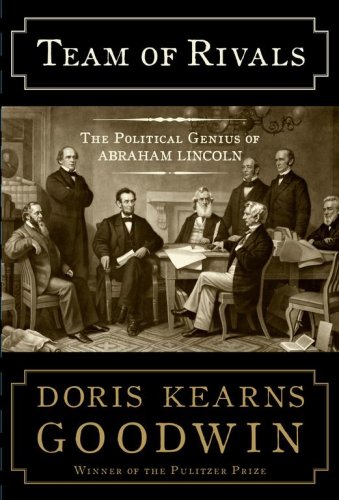
I argued yesterday in an op-ed for the Los Angeles Times that Lincoln’s experience with cabinet-making (the famous “Team of Rivals”) was more of a cautionary tale than a model to follow.
Consider this inconvenient truth: Out of the four leading vote-getters for the 1860 Republican presidential nomination whom Lincoln placed on his original team, three left during his first term — one in disgrace, one in defiance and one in disgust.
The article stirred up a decent response. The New York Times Opinionator addressed the topic. Daily Kos offered a poll pitting my interpretation against the more famous one by Doris Kearns Goodwin (I’m losing, by the way). And there’s been calls and emails from various reporters.
Lincoln is the Great Example and all of us want to try to understand what his experience represents. Look at the evidence yourself, or with your students, and decide for yourself. Nothing could be more timely.
21
Jul
08
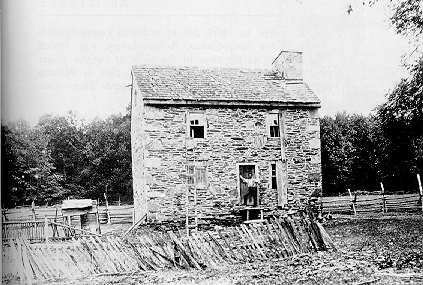 Ella Forbes, former professor of African American studies at Temple University and author of “But We Have No Country: The 1851 Christiana, Pennsylvania Resistance,” has written an article on the use of violence at the Christiana Resistance. Forbes argues that the use of violence at Christiana is “…an indication of the alienation blacks felt in a nation which showed its hostility so openly towards them, a nation unwilling to protect them from white violence, a nation whose very laws promoted their disenfranchisement.” Forbes’ article in the Journal of Negro History makes its point clearly, and illustrates in great detail social and political alienation experienced by both enslaved and freed African Americans living in the antebellum United States. The article is worth reading for its insight alone, though the article presents an important teaching moment: Use and analysis source documents and materials. Forbes cites heavily William Parker’s narrative in support of her argument. But there is question as to the authorship of the narrative, as this website from Millersville University explains. Parker, the only individual involved in the Christiana Resistance to have published an account, received help in compiling his memoir from an editor identified by only the initials “E. K.” Since it is not known who this individual was, it is difficult to gauge the editor’s mark on the work. Is Parker’s narrative a reliable, factual work or did it suffer alteration by “E.K.” for his own propagandistic purposes? Provides a great springboard for discussion about primary source materials, bias, and analysis of Forbes’ article. The full bibliographic citation for Forbes’ article is below.
Bibliographic Citation: Forbes, Ella. “‘By My Own Right Arm’: Redemptive Violence and the 1851 Christiana, Pennsylvania Resistance.” Journal of Negro History 83, no. 3 (1998): 159-167.
10
Jul
08
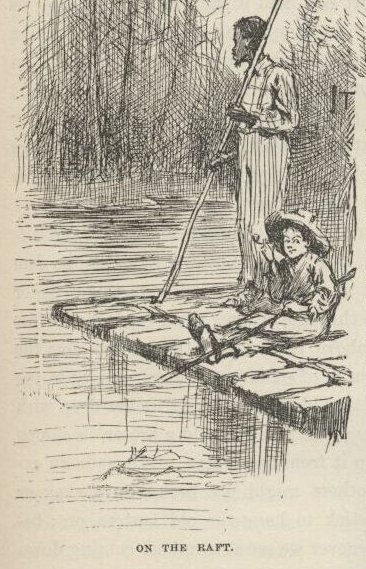 The Adventures of Huckleberry Finn by Mark Twain is a classic story about the adventures of a young boy growing up along the Mississippi River, who helps the slave Jim escape. Published in 1884, the book portrays how life was in antebellum South. The novel is known as one of the first novels to take dialect into account. A free audio version of the book can be found online. As a supplement to a lesson about fugitive slaves, excerpts from the book can be played to give the students a fantastic story with accurate dialect.
14
Apr
08
The Lincoln-Douglas Debates Unplugged
Published in Antebellum (1840-1861), General Opinion Themes: Contests & Elections In this book review published on Slate.com, historian David Greenberg examines a new book on the Lincoln-Douglas debates, Lincoln and Douglas: The Debates That Defined America written by Allen C. Guelzo of Gettysburg College. With campaigning for the upcoming presidential election in full swing, debates will surely play a big role in swaying public opinion toward or away from a particular candidate. With that in mind, it might be an interesting time to reexamine the Lincoln-Douglas debates from a new perspective. According to Greenberg, Guelzo’s book helps to demystify the significance of the debates and present a clearer picture of the divergent positions taken by the incumbent Senator Douglas and the up-and-coming Lincoln. This might be a new piece of scholarship worth checking out.


