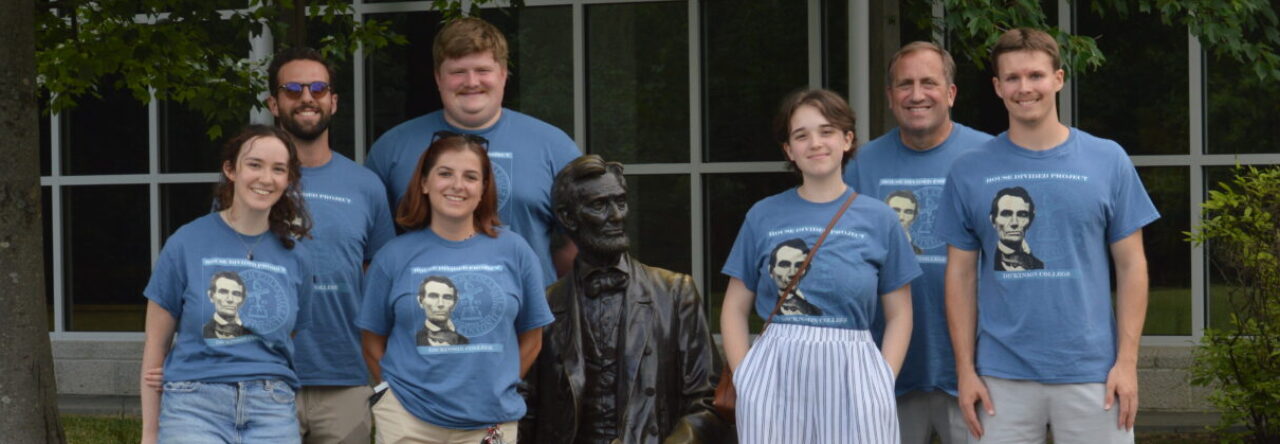
https://www.wevideo.com/view/4150270874
Introduction
Facing the nation’s most significant Republican political figures, including Supreme Court Justices and President Ulysses S. Grant, Frederick Douglass eulogized Abraham Lincoln, the party’s most revered martyr, as neither “our man or our model,” but as “the white man’s President” in all of his prejudices and conducts. [1] He delivered this assessment on April 14th, 1876, the 11th anniversary of Lincoln’s assassination, to commemorate the unveiling of the Emancipation Memorial in Washington, D.C.. The bronze statue was fully funded by African American donations, but the monument itself does not represent this power and resilience post- slavery, but rather depicts a Black man in an inferiorly crouched position at Lincoln’s feet. Douglass used his speech not to attack Lincoln’s legacy or character, but to challenge the narrative that emancipation and the elevation of African Americans occurred because of white political benevolence. At a fearful time of violent white supremacism, government dismissal of Black oppression, and the loss of civil liberties, Douglass sought to correct the history of emancipation and idealization of white Republicans. In his speech, Douglass deconstructed Lincoln’s characterization as a purely benevolent emancipator and highlighted African American agency in order to mobilize Black resistance to the rollback of civil rights at the end of the Reconstruction Era.
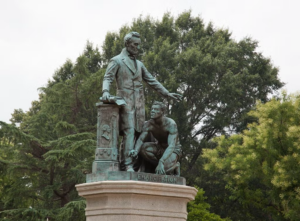
Emancipation Memorial (Washington.org)
Text
Douglass delivered his speech to a diverse crowd that represented a microcosm of the nation’s population; among those attending the memorial were African Americans, including funders of the memorial itself, Civil War veterans and generals, government officials, and white citizens. [2] In this 880 word excerpt of a longer statement, Douglass constructed a nuanced profile of Lincoln that acknowledged both his prejudices as a “white man’s president” and undeniable success in abolishing slavery. [3]
He began by critiquing Lincoln’s consistent commitment to the “interests of his own race” and consequential deprioritization of the Black population, who were “not the special objects of his consideration.” [4] He emphasized Lincoln’s worthiness to be exonerated by white Americans, thus highlighting the generosity and magnitude of the memorial’s complete funding from formerly enslaved people. Douglass repeatedly blamed Lincoln’s pragmatism and devotion to the limits of the Constitution for his willingness to “perpetuate slavery in the states where it existed,” “send back the fugitive slave to his master,” “suppress a slave rising for liberty,” and inadvertently prolong the suffering and bondage of the enslaved. [5]
Despite these criticisms of Lincoln, Douglass empathized with his presidential duty to balance the polarized climate of Civil War America, conceding that if Lincoln had “put the abolition of slavery before the salvation of the Union, he would have “inevitably driven from him a powerful class of the American people and rendered resistance to rebellion impossible.” [6] Douglass concluded by invoking Lincoln’s own words to showcase his opposition of slavery and ultimately praised his abolitionist actions in the context of his position.
Context
Douglass’s choices to challenge a purely heroic image of Lincoln and emphasize Black agency were rooted historical precedent. African Americans were participants in every step towards abolition and Union victory, often independently beginning movements that were later followed with government policy or support. Nearly 200,000 African Americans served in the United States Army and Navy first after the passing of the Second Confiscation Militia Act in July, 1862 and more broadly after the issuing of the Emancipation Proclamation in 1863. Douglass was crucial in mobilizing Black enlistment, with his 1863 speech “Men of Color, to Arms!” which argued that Black men had a duty and rightful place to serve in the Union Army to secure their own freedom. Douglass viewed service as a sure way to gaurantee civil rights after the war, and said “there is no power on earth that can deny that he has earned the right to citizenship,” in his speech entitled “Should the Negro Enlist in the Union Army?” [7] His strategy proved true in the passing of the Reconstruction Amendments, which secured numerous civil rights for Black Americans, including but not limited to the abolition of slavery in the Thirteenth Amendment, the establishment of birthright citizenship and equal protection under the law for citizens in the Fourteenth Amendment, and the protection of Black men’s right to vote in the Fifteenth Amendment. [8]
By the spring of 1876, however, these rights and advancements were under attack. Mere weeks before Douglass eulogized Lincoln and contextualized the significance of the emancipation memorial, the United States v. Cruikshank decision was delivered. The Supreme Court Case arose from a massacre of Black citizens and militiamen in Colfax, Louisiana who were occupying a courthouse in order to protect their right to vote in a local election. The ruling interpreted the Fourteenth Amendment to allow the Federal Government to punish States at large for civil rights violations but not individual criminals. The ruling failed to condemn the white supremacist terror groups that committed the violence or implement any policy to dissuade future attacks. [9] The Colfax Massacre was one of many instances of Southern paramilitary groups such as the Red Shirts in South Carolina or the Ku Klux Klan who threatened Black lives and civil participation with little consequence from Southern Governments. The ruling left African Americans increasingly vulnerable to violence as Black Codes began to morph into formal Jim Crow Laws at the end of Reconstruction and the withdrawal of Union troops from the South after the 1876 election took full effect. [10]
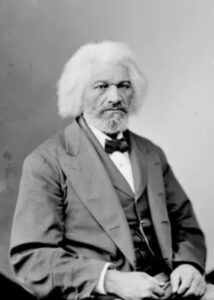
Frederick Douglass as a Statesman (Library of Congress)
Subtext
Douglass identified and anticipated the threat to civil rights that would ensue in the following years, and used his platform at the emancipation memorial to discourage blind trust and the martyring of white Republican politicians, including Lincoln. Douglass refused to shy away from Lincoln’s shortcomings, despite the honorable tone of the occasion. He highlighted Lincoln’s faults in aiding in the return of fugitive slaves to their enslavers and the suppression of slave uprisings in the South. In his statement, Douglass constructed two crucial points that shifted perspectives to recognize Black agency. First, Douglass dismantled the narrative previously assigned to Lincoln as the colored people’s “best friend,” as exclaimed by Charlotte Scott, the formerly enslaved woman who made the first donation towards the monument, or the “black man’s president,” as Douglass previously called him in 1865. [11] He opposed his previous tone by charging Lincoln with being willing to “sacrifice the rights of humanity in the colored people to promote the welfare of the white people.” [12] Through Douglass’s rejection of Lincoln as a savior figure or “great emancipator,” he dismantled the view that white benevolence was the only path to political power and therefore encouraged Black agency and independence. Secondly, Douglass made reference to two methods of Black self-emancipation, a reality not represented in the monument, and reminded his audience that enslaved people took action to liberate themselves- actions which were curbed by Lincoln’s strict adherence to law, order, and political appeasement.
Later in his speech, Douglass admitted Lincoln’s validity and strategy in being pragmatic and considerate of the delicate balance of political interests in the country. Thus, Douglass’s objective was not to condemn Lincoln but to emphasize the dangers of executing the law to serve the interests of the white race. In the context of the United States V. Cruikshank case, the Supreme Court ruling claimed that the Constitution did not grant the government authority to punish white supremacist terrorist groups, thus allowing the violation of Black liberty under the guise of legal formalities. Douglass illuminated a similar downfall in Lincoln’s early policies, and stated Lincoln’s fear of driving “from him a powerful class of the American people” as the cause for his decision to make abolition secondary to the preservation of the Union. [13] In his reference to Lincoln’s political caution and concession over abolition in order to appease the nation’s opinions, Douglass implied that a similar danger lay in the future of Black civil rights if the Federal Government conceded to the opinions of the South and failed to implement safeguards for liberty. In the context of the rollback of civil rights for African Americans, Douglass used Lincoln’s early policies as a lesson against the reliance on white Republican benevolence, thus reinforcing the necessity for continued Black agency, as exemplified in self-emancipation and the very funding of the emancipation memorial.
Conclusion
Douglass used his platform at the memorial to move beyond eulogizing Lincoln to challenging the remembrance of history. He invoked a form of “people’s history” by refusing to accept those in elevated positions of power as the only agents of change. He recognized that rights are not simply handed down from institutions of power but are hard won by the marginalized groups affected. In emphasizing the power of grassroots movements, Douglass established a blueprint that would endure throughout the fall of Black civil liberties post-reconstruction. Although the nation was smothered by segregation, violent terror groups, and federal government resignation, African Americans never ceased in the fight for rights and equality. In his work, Douglass gives a voice and a power to the Black soldier, the self-emancipator, or the freedman who funded the monument. In shifting the authority of liberation and democracy from politicians or individuals in power to the average citizen, Douglass instilled future generations with strength and agency to institute progress and reject oppression.
- Frederick Douglass, “Speech at Dedication of Emancipation Memorial,” 1876, House Divided, para. 1, [WEB].
- National Republican, (Washington, DC), Apr. 15 1876, [WEB]
- Douglass, “Speech at Dedication of Emancipation Memorial,” para. 2.
- Douglass, “Speech at Dedication of Emancipation Memorial,” para. 2.
- Douglass, “Speech at Dedication of Emancipation Memorial,” para. 2.
- Douglass, “Speech at Dedication of Emancipation Memorial,” para. 3.
- “Black Soldiers in the U.S. Military During the Civil War,” National Archives, accessed Aug 7, 2026, [WEB].
- “Reconstruction Amendments,” House Divided [WEB].
- Pamela Brandwein, “A Judicial Abandonment of Blacks? Rethinking the “State Action” Cases of the Waite Court,” Law & Society Review 41, no. 2, (2007): 343–386, [JSTOR].
- Daniel Byman, “White Supremacy, Terrorism, and the Failure of Reconstruction in the United States,” International Security 46, no.1 (2022), 53–103, [WEB].
- National Republican; Douglass, “Speech at Dedication of Emancipation Memorial,”
- Douglass, “Speech at Dedication of Emancipation Memorial,” para. 2.
- Douglass, “Speech at Dedication of Emancipation Memorial,” para. 3
Leave a Reply