
Lincoln and Douglass’s Approaches to the Anti-Slavery Movement and the Emancipation Proclamation.
“Mr. Lincoln seemed tardy, cold, dull, and indifferent,” recalled Frederick Douglass during a speech in 1876. “But measuring him by the sentiment of his country, a sentiment he was bound as a statesman to consult, he was swift, zealous, radical, and determined.” [1] These words captured Douglass’s conflicted view of President Abraham Lincoln’s strategy for emancipation. Douglass thought of him as often too cautious in the moment. But when pressured by Douglass, he was decisive in the fight against slavery. In the early years of the Civil War, the two men had always stuck to their strategies when pursuing abolition; Lincoln prioritized building his base, while Douglass pressed for urgent, immediate change. In the end, their eventual clash over the Emancipation Proclamation revealed that lasting progress often requires the tension between moral urgency and political pragmatism, a lesson still relevant for today’s political world.
Douglass’s approach to the Anti-Slavery Movement
Frederick Douglass had begun his journey for abolition as part of the Garrisonian movement, which he had joined immediately after his escape from slavery. The abolitionist movement, founded by William Lloyd Garrison, was pacifist. It had rejected the use of force in the struggle against slavery; instead, they went around using moral persuasion to turn the general population against slavery. Furthermore, they were against the Constitution, which most members of the movement thought of as a pro-slavery document. [2] In his early years, Douglass, for the most part, stood with Garrison and declared his relationship to him as “something like that of a child to a parent.” [3]
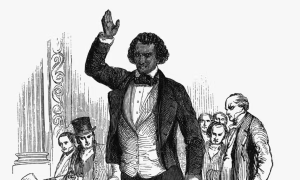
Douglass giving a speech to an abolitionist crowd
Over time, Douglass began to break away from Garrison. He grew convinced that moral suasion alone was insufficient and that the Constitution was indeed a document that could be used as a tool to argue for the eradication of slavery. Furthermore, Douglass had become frustrated by the Compromise of 1850, insisting that the issue of slavery could not be dropped from political discussion, even though after the compromise, many in politics “swore to the heavens that they would not mention the subject again.” [4] This was the final nail in the coffin for Douglass, who, in his famous 1852 speech, “What to the Slave Is the Fourth of July?”, thundered against American hypocrisy and used a fiery tone to demand that the nation confront slavery head-on. [5]
Douglass’s strategy was strategically transformative for his time, as Philip Yaure argues in Deliberation and Emancipation. Douglass distrusted “reasonableness” and civil discourse, as it delayed emancipation and often ignored tempered progressive voices like his own. [6] Yet Douglass’s method had its flaws. According to the historian James Oakes, Douglass jumped around party politics and often switched up his endorsements many times in one election cycle.[7] This inconsistency meant that, while his voice carried immense moral force, Douglass lacked the political coalition and friendships needed to pass laws and enact political change. Still, his uncompromising voice carried tremendous power, and without his pressure, slavery’s end may have come far more slowly than it did.
Lincoln’s approach to the Anti-Slavery Movement
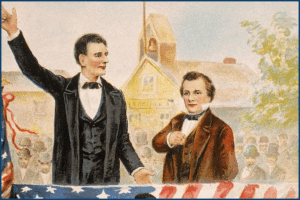
Lincoln during the 1858 Senate campaign
Abraham Lincoln began his anti-slavery approach as someone who was opposed to slavery privately, but often offered it a measure of cautious public support. His view is seen in his letter to his friend Joshua Speed, where he said that “he hated to see the poor creatures [slaves] hunted down and caught” but that he had to bite his lip and stay quiet about it in public. [8] However, as he became a rising star in the Republican Party, he began to give more public voice to his private views. In his famous “House Divided Speech”, he declared his intentions to stop the spread of slavery and then proclaimed, “I believe this government cannot endure, permanently half-slave and half-free.” Lincoln’s declaration set forth his plan to advocate for an eventual abolition of slavery in the U.S. However, he was also careful to denounce any sort of violent and fiery abolitionists, such as John Brown, whom he criticized vehemently for his unsuccessful and violent attempt to end slavery in the U.S.[9] Lincoln was eventually able to create a massive political coalition under the Republicans and rise to the presidency on a moderate anti-slavery platform that focused mainly on stopping the expansion of slavery rather than the direct abolition of it. Even when the Civil War began, Lincoln restrained himself from making the war about slavery until later years. He concentrated instead on holding the Union together and building a coalition that would eventually allow for the total emancipation of slavery.
This cautious strategy had both advantages and drawbacks. On one hand, Lincoln was able to create a broad coalition which made him more electable. However, some historians compared Lincoln’s strategy to that of a tortoise. Unlike Douglass, Lincoln did not let his personal feelings influence his decision as a president, which hindered his ability to bring about change. [10] This caused him to be naturally slower than Douglass at helping eradicate slavery, as he had to filter more of what he said in order not to alienate his base. Despite Douglass’s frustrations with Lincoln, the president’s plan was ultimately effective and eventually paved the way for change and the end of slavery.
Lincoln and Douglass’s strategies converge.
In the second year of the war, Lincoln and Douglass’s strategies came together at one of the most important moments: the battle for the Emancipation Proclamation. At the start of 1862, Lincoln had started to seriously consider an emancipation order that eventually freed all slaves in the Confederacy. However, as historian James Oakes describes, Lincoln wanted to push for a so-called “colonization” plan to be included as part of the Constitution. This was the movement, backed by white Americans and some blacks, to return freed slaves to Africa and the Caribbean.[11] Lincoln believed that this would have prevented backlash from his northern white base, as many were wary of having 4 million freed blacks in the U.S. Douglass, though, called him out and put public pressure on the president. Douglass declared that Lincoln’s push for colonization revealed he was simply a “representative of American prejudice and black hate.” [12] Douglass did not just push against the colonization movement; he publicly used his voice and strategy to pressure the administration to allow black Americans to fight in the US army, he declared in his “Men of Color, to Arms speech,” “Let the black soldier get an eagle on his button, and a musket on his shoulder, and bullets in his pocket.” [13] Overall, Douglass’ argument showed the flaws in Lincoln’s political strategy, illustrating how he had valued protecting his base over achieving change. The speech also showed how Douglass’s strategy made up for the weaknesses in Lincoln’s. Douglass was able to use this voice to publicly campaign for black regiments in the US army. The argument was important because fighting for freedom in the Union army helped affirm a place for black Americans in the United States, as citizens, and not some group that should be sent to a colony overseas.

Signing of the Emancipation Proclamation
Douglass’ push for immediate emancipation also had its flaws, too, as he often ignored the political realities at the moment. Before September 1862, the South had the upper hand in the Civil War. Lincoln, though cautious in Douglass’s eyes, chose to wait for a Union victory before issuing emancipation, ensuring it gained broader support. That victory occurred in September 1862 at the Battle of Antietam and gave Lincoln the momentum to issue the Emancipation Proclamation with the backing of renewed Union morale. On January 1st, 1863, Lincoln signed the Emancipation Proclamation, which freed all enslaved people in the Confederacy. Attached below was Douglass’s idea: a clause that stated that black Americans “will be received into the armed service of the United States.” [14]
In the end, Douglass’s moral pressure and Lincoln’s political caution had to come together to make emancipation both possible and lasting. This is still a problem today in politics; many do not know when to balance slow coalition building with a quicker and potentially less well-supported change. But this moment in history reveals the perfect balance of both; while it is essential to build a coalition, often politicians spend too much time protecting it, and they forget to enact the change it was meant to bring. This is why advocating for change is essential, as it lets the people in power remember why they were elected. However, if a change is made too soon and the majority of the country is not in favor of it, there is a potential risk to its durability and long-term success. Ultimately, today, politicians and the public must know how to balance both strategic patience and moral urgency in order to achieve effective change.
[1] “Frederick Douglass, Emancipation Memorial Speech (1876),” Knowledge of Freedom Seminar [WEB]
[2] James Oakes, The Radical and the Republican: Frederick Douglass, Abraham Lincoln, and the Triumph of Antislavery Politics (New York: W.W. Norton, 2007), 17.
[3] Oakes, Radical 18.
[4] Oakes, Radical 20.
[5] “Frederick Douglass, Fifth of July Speech (1852),” Knowledge of Freedom Seminar [WEB]
[6] Phillip Yaure. “Deliberation and Emancipation: Some Critical Remarks.” Ethics 129, no. 1 (2018): 8–38. [WEB]
[7] Oakes, Radical 24.
[8] Abraham Lincoln. “Private Letters (1855),” Knowledge of Freedom Seminar [WEB]
[9] Oakes, Radical 75.
[10] Eugene H Berwanger. “Lincoln’s Constitutional Dilemma: Emancipation and Black Suffrage.” Papers of the Abraham Lincoln Association 5 (1983): 25–38. http://www.jstor.org/stable/20148825. [WEB]
[11] Oakes, Radical 192.
[12] Oakes, Radical 194.
[13] “Frederick Douglass, Men of Color, To Arms (1862)” Knowledge of Freedom Seminar [WEB]
[14] Abraham Lincoln, “Transcript of the Proclamation (1863)” National Archives [WEB]
1 Pingback