
Sojourner Truth, Woman’s Rights Speech (1851)
“May I Say a Few Words?”[1]
“May I say a few words?” began Sojourner Truth in May of 1851, at the Woman’s Rights Convention held in Akron, Ohio. Born into slavery around 1797 and only emancipated in 1827 under New York’s gradual abolition law, Truth never had the opportunity to learn to read or write. Despite this, she was widely known for her ability to deliver massively articulate speeches—often as part of long tours on topics such as emancipation and women’s rights. But despite her prowess, she was never the central figure at large conventions, and her orations were seldom transcribed fully into newspapers. As historian Nell Irvin Painter posits, “She was considered a speaker who could be relied upon to be brief, idiosyncratic, and highly entertaining.” This was as opposed to others—most notably Frederick Douglass—who were generally more formal or thorough.[2]
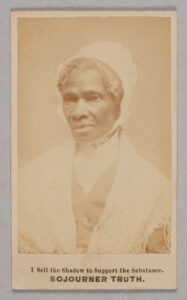
Truth’s carte-de-visite. She was known for the message included below the photo. (National Museum of African American History and Culture)
The likely reason for this was common between nearly all of Truth’s orations, including this particular speech: the fact that they were delivered extemporaneously. Even if the newspapers did not agree on her merit, it was evident that Truth’s impromptu quality offered something that captured her audiences in a new way. Truth’s popularity became undeniable.[3] Her “entertainment value,” though, may have been the byproduct of her mastery of a specific technique. Throughout this speech, Truth exemplifies one of the most effective rhetorical strategies open to those who wish to expose hypocrisy: a tidy blend of logic and irony.
The Hawk
“Receiving an affirmative answer” after she asked to speak, Truth began by arguing that men and women were physically equal in terms of ability.[4] In following with the intent of the convention, her speech predominantly argued for women’s rights and equality, attempting to prove the truth of “the sexes being equal.”[5]
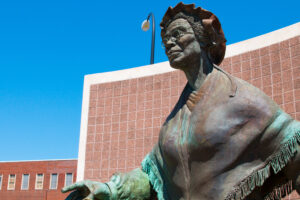
A statue of Truth in Battle Creek, Michigan, where she spent much of her later life. She stands behind a lectern. (Calhoun County Visitors Bureau)
However, Truth made sure to never forget any piece of her identity. For this reason, she also made several references to the cause of abolition—“the poor slave is on [the white man],” she stated—underscoring the theme that liberty for only one group is not liberty at all.[6]
Truth ended her speech by establishing her confidence in multiple social movements, viewing full equality as inevitable. It was her view that “man is in a tight place…between-a hawk”—by which she meant the current state in which feminists and abolitionists were actively attacking the oppression of white men—“and a buzzard.”[7] The buzzard, of course, was a symbol for the demise of that oppressive social order, as the birds are known for eating dead animals.
“The Course of Human Events”[8]
Truth was certainly correct about the hastening of societal shifts. In
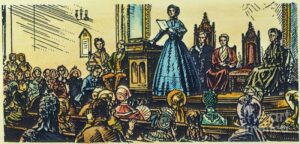
A depiction of the reading of “The Declaration of Sentiments.” (Medium)
1848, the famed Seneca Falls Convention—the event at which Elizabeth Cady Stanton first unveiled her “Declaration of Sentiments,” which used the “Enlightened” language of the founders to argue for the equal rights of women—was held. This was the first gathering of its sort to occur in the country, and is thus viewed by most historians to have been the beginning of organized American feminism. Following Seneca Falls, such conventions became a hallmark of the movement, as they helped to formalize and unify the cause. The Akron Convention at which Sojourner Truth delivered this speech was a meeting grounded in the legacy of 1848.
“As for Intellect”[9]
Truth’s brevity was perhaps her greatest tool: she wasted no time in establishing her audience and intent. She spoke overtly to “Man,” and while she invoked powerful metaphors and allusions, she never strayed into convolutions. (The most abstract she got was the introduction of a religious argument, which in the context of the time was really more of a method for a common understanding of life rather than a figurative device.[10])
Instead, Truth relied on an intensely logical, satiric argument with which she hoped to force her opposition into conceding something, even if they would not acknowledge all of her points. As Truth moved into the fourth and fifth paragraphs of the transcribed speech, she turned the discussion to “intellect.” Her tactic hinged on the following question: “If women have a pint and man a quart – why can’t she have her little pint full?”[11] On the surface of this statement, it might have appeared that Truth truly believed women to be inferior to men in their intellect…but nothing else in the speech really indicated that. Just prior, she had listed all the ways in which the sexes were physically equal. So why halt there? She did so because she knew her audience. (Again: men.) “Intellect” differed from physical ability because ideas and opinions are much more easily dismissed as “subjective” or simply “wrong,” especially by those in power. Thus, she could not have proven this argument in the same way. But to Sojourner Truth, this was no obstacle. She could meet them where they were, and still win the day.
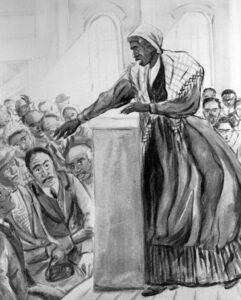
A depiction of Sojourner Truth delivering a speech. (Picturing Black History)
Both possible answers to Truth’s clever question—“why can’t she have her little pint full?”—were beneficial to her argument; each caused her audience to make an admission. The first option was as follows: If men continued to promote their belief that women were intellectually inferior, then it made no sense to continue withholding women’s rights. If they truly had just “a pint” to men’s quarts, there should have been no danger of women becoming “too” powerful through a full recognition of rights—and thus no harm in conceding them.[12] On the opposite side of this, if powerful men continued to refuse women those rights after hearing Truth speak, then that became just as good as an admission that women, in fact, did have an equal “quart.” With her simple question, Truth revealed the true fears and prejudices of her male opponents. There was no answer that they could have given without looking at best supremely foolish—and at worst, perhaps most truthfully, like real tyrants.
Besides the use of this logical trap—and this is what brought her speech fully into the realm of a satiric work—Truth’s most powerful technique was her assumption of a persona. This was a strategy that she used often, having been described as adopting a “naïve persona” specifically.[13] The reason that this worked so well in her case was because it played into stereotypes that her opponents believed about her, being an illiterate Black woman. When she addressed her skeptical audience during this speech, Truth exaggerated this perception of herself in order to appear harmless. This method allowed Truth to direct her arguments at the core of each issue, reducing them to their “simple” fundamentals—avoiding irrelevant, inapplicable caveats brought up by opposition. Further, she was able to safely address her audience using a tone that might have otherwise been viewed as patronizing or disrespectful—which of course it actually was. When Truth informed her male audience that “the poor men seem to be all in confusion,” and supplied the solution: “Why children, if you have woman’s rights, give it to her,” her true incredulity at the patriarchal institution was probably taken instead as an earnest but ignorant Black woman misunderstanding that “rights” are not a physical thing. But it is also likely that she was better received than she otherwise would have been, because she did not present an obvious challenge—she “did not force her white audiences to adjust their preconceptions about race and sex.”[14] Her hope, though, was that her Trojan horse of an argument had gotten through.
The (Sojourner) Truth
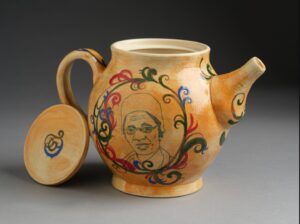
Artwork by potter and social activist Roberto Lugo, titled “Ain’t I?” As of this writing, the piece is on display at Dickinson College’s Trout Gallery. (Trout Gallery – Instagram)
Sojourner Truth is often misremembered as a real-life version of the persona she adopted in this speech. Over time, various writers—including her contemporaries; figures like Harriet Beecher Stowe and Frances Gage—have commandeered her image to fit ulterior narratives, and when she is thought of today it is most often with the stereotypical “ain’t I a woman?” (which she never actually said).[15] The reality, though, is vastly different: Truth may have been an unconventional speaker, but she was nothing to be dismissed by it. Her astuteness for including ironic elements and winning her audiences’ favor was the reason her arguments struck such a deep and lasting chord.
Hyperlink to WeVideo Reading
[1] “Sojourner Truth, Woman’s Rights Speech (1851),” Knowledge for Freedom Seminar, accessed July 20, 2026, https://housedivided.dickinson.edu/sites/teagle/texts/sojourner-truth-womans-rights-speech-1851/.
[2] Nell Irvin Painter, “Sojourner Truth in Life and Memory: Writing the Biography of an American Exotic,” Gender & History 2, no.1 (1990): 7, https://housedivided.dickinson.edu/sites/teagle/files/2021/07/Painter-article.pdf.
[3] Painter, “Sojourner Truth,” 3.
[4] “The Sojourner Truth Project,” The Sojourner Truth Project, accessed July 20, 2026, https://www.thesojournertruthproject.com/?gad_source=1&gad_campaignid=822015968&gbraid=0AAAAADLXsdoIq_0OXIAofbLMX3OsG0G9x&gclid=EAIaIQobChMIxPPdo93hlQMVrGBHAR2h5ApnEAAYASAAEgKkR_D_BwE.
[5] “Sojourner Truth.”
[6] “Sojourner Truth.”
[7] “Sojourner Truth.”
[8] “Declaration of Sentiments (1848),” Knowledge for Freedom Seminar, accessed July 20, 2026, https://housedivided.dickinson.edu/sites/teagle/texts/declaration-of-sentiments-1848/.
[9] “Sojourner Truth.”
[10] “The Founders and Freedom of Religion: An Introduction,” James Madison Foundation, accessed July 20, 2026, https://www.jamesmadison.gov/system/files/assets/teach-the-constitution/lessons/01_FoundersFreedomReligion.pdf.
[11] “Sojourner Truth.”
[12] “Sojourner Truth.”
[13] Painter, “Sojourner Truth,” 10.
[14] Painter, “Sojourner Truth,” 10.
[15] Painter, “Sojourner Truth,” 8; “The Sojourner Truth Project.”
Leave a Reply