
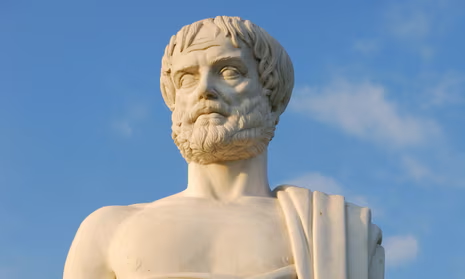
Statue of Aristotle courtesy of The Guardian.
In “Politics,” written around 350 BCE, Aristotle addressed the institution of slavery within the context of ancient Greek society, where slavery was not only accepted but deeply integrated into social and economic structures. At this time, Greece was composed of various city-states, with Athens being particularly influential due to its democratic government established by Cleisthenes in 508 BCE [1]. Slavery was essential to the functioning of city-states like Athens, where enslaved people provided the labor necessary for agriculture, domestic service, and various other forms of manual work [2]. Within this context, Aristotle proposed his theory of natural slavery, asserting that “from the hour of their birth, some are marked out for subjection, others for rule” [3]. This theory suggested that certain individuals were inherently suited to be slaves, just as others were naturally suited to be masters, a relationship that he analogized to the rule of the soul over the body. Despite Aristotle’s firm assertions, his arguments were riddled with inconsistencies and contradictions that revealed a struggle to fully reconcile the institution of slavery with his philosophical commitments. These contradictions, though not intentionally crafted to challenge the practice of slavery, inadvertently exposed the inherent difficulties in justifying an institution that clashed with the concepts of justice and virtue central to Aristotle’s ethical philosophy.
Aristotle’s assertion that slavery was natural stemmed from his belief in a hierarchical order embedded in the universe. This belief followed the general Greek philosophical tradition, heavily influenced by Plato’s “Republic” (circa 380 BCE), which also emphasized a structured society where each individual had a predetermined role [4]. Aristotle likened the relationship between master and slave to that of the soul and body, arguing that “the rule of the soul over the body, and of the mind and the rational element over the passionate, is natural and expedient” [5]. This analogy was intended to justify slavery as both necessary and beneficial, positing that some people, who lacked the rational capacity to govern themselves, were naturally suited to be ruled by others. In this view, the subjugation of certain individuals was seen as part of the natural order and beneficial to those who were naturally destined for servitude. However, Aristotle’s discussion of slavery quickly revealed internal contradictions when he introduced the concept of slavery by law, as distinct from natural slavery. He acknowledged that “there is a slave or slavery by law as well as by nature,” and that the law was a “sort of convention” [6]. This acknowledgment coincides with the prevalent legal structures of the time, such as the Draconian laws in Athens (circa 621 BCE), which laid down harsh legal codes, including those related to slavery [7]. This admission that slavery could be established by convention rather than by nature raised doubts about the validity of his earlier claims. If slavery could be imposed through human laws, it undermined the idea that slavery was inherently natural, casting doubt on the legitimacy of Aristotle’s justification for slavery.
Further complicating his argument, Aristotle questioned the morality of enslaving those captured in war, a common practice in ancient Greece. During the Peloponnesian War (431–404 BCE), for instance, entire populations were enslaved as a consequence of defeat, illustrating the prevalence of such practices [8]. He asked, “For what if the cause of the war be unjust?” [9] This question challenged the legitimacy of enslavement based on circumstances such as war, suggesting that not all slaves were naturally suited to their condition and that the circumstances of their enslavement might be morally indefensible. Aristotle also disputed the notion that non-Greeks, or “barbarians,” were naturally suited to slavery, a common belief among Greeks. He observed, “The Hellenes regard themselves as noble everywhere, and not only in their own country, but they deem the barbarians noble only when at home, thereby implying that there are two sorts of nobility and freedom, the one absolute, the other relative” [10]. This reflects the general political situation of the time, particularly after the Persian Wars (499–449 BCE), where Greeks saw themselves as culturally and morally superior to the Persian “barbarians” [11]. This recognition that cultural differences, rather than inherent qualities, often determined who was enslaved and who was free, further destabilized his theory of natural slavery by acknowledging the arbitrary nature of such distinctions.
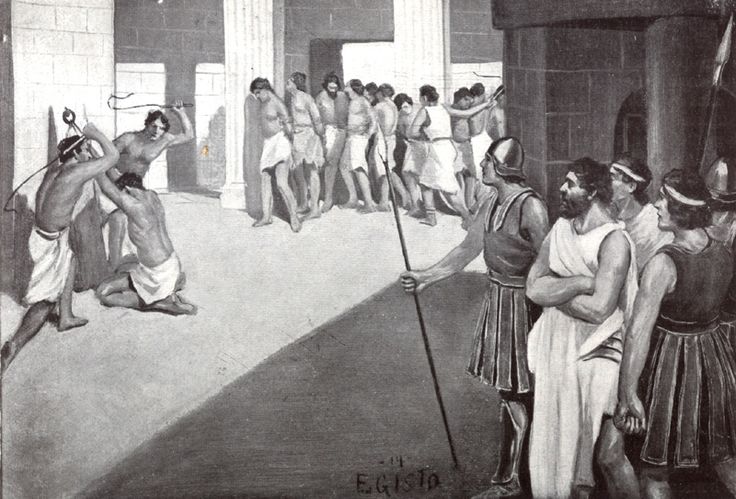
Portrait of Slavery in Ancient Greece courtesy of Britannica
The inconsistencies in Aristotle’s argument became even more apparent when he discussed the characteristics of the natural slave. He described the natural slave as someone who “participates in rational principle enough to apprehend, but not to have, such a principle,” suggesting that slaves possessed some degree of reason but lacked the full capacity for rational thought [12]. Such views can be seen as part of a larger intellectual tradition in Greece that valued reason, particularly after the intellectual revolution of the 5th century BCE, when figures like Socrates challenged traditional views on morality and governance [13]. Yet, Aristotle conceded that “nature would like to distinguish between the bodies of freemen and slaves […] the opposite often happens—that some have the souls and others have the bodies of freemen” [14]. This statement undermined the idea that natural slavery was a clear and inherent condition, implying instead that nature did not reliably separate those who were fit for freedom from those who were not. Aristotle’s observation that “the beauty of the body is seen, whereas the beauty of the soul is not seen” further complicated his justification, exposing the subjective and arbitrary nature of judgments about who was naturally suited to slavery [15]. These contradictions suggested that Aristotle’s arguments for slavery were not entirely convincing, even to himself. His acknowledgment of the possibility of unjust wars, the role of cultural distinctions, and the difficulty in identifying natural slaves all pointed to a deeper unease with the institution of slavery. While Aristotle attempted to justify slavery through natural law and reason, his own arguments revealed the challenges in defending an institution that fundamentally contradicted the ideals of justice and virtue that were central to his philosophy.
Agnes Callard, in her essay “Should We Cancel Aristotle?”, offers a perspective on Aristotle’s contradictions. She argues that Aristotle’s defense of slavery is deeply rooted in his belief in the inequality of human beings, a belief that cannot be easily dismissed as merely a product of his time [16]. Callard acknowledges the troubling nature of Aristotle’s views but suggests that his inconsistencies reflect the inherent tension between his hierarchical beliefs and the moral implications of slavery. She argues, “As I read him, Aristotle not only did not believe in the conception of intrinsic human dignity that grounds our modern commitment to human rights, he has a philosophy that cannot be squared with it” [17]. This implies that Aristotle’s contradictions are not simply accidental but are indicative of the philosophical challenges he faced in trying to justify an institution that was fundamentally at odds with the principles of justice and virtue.
In contrast, Steven B. Smith, in his analysis of Aristotle’s views on slavery, recognizes these contradictions and argues that they reflect the limitations of Aristotle’s own philosophical reasoning rather than a deliberate strategy. Smith emphasizes Aristotle’s method of presenting multiple perspectives, noting that Aristotle’s discussion of slavery in Politics is no exception. He points out that Aristotle’s acknowledgment that nature “often” failed to differentiate between slaves and freemen indicates that Aristotle was grappling with the inadequacies of his own theory [18]. Smith asserts that these contradictions are not “maddeningly equivocal” but rather point out Aristotle’s struggle to reconcile the social realities of his time with his ethical commitments. According to Smith, “What Aristotle’s true views on slavery might have been is probably impossible to say. He remains the proverbial riddle wrapped in a mystery inside an enigma” [19]. This suggests that Aristotle was aware of the moral difficulties in justifying slavery but was unable to fully resolve them within his existing reasoning.
Aristotle’s treatment of slavery in “Politics” revealed a deep conflict between his attempt to justify the institution and the inherent difficulties in doing so. The contradictions in his arguments suggested that his justification for slavery was not fully coherent and that he may have been struggling to reconcile the practice with his ethical beliefs. While Aristotle’s theory of natural slavery was intended to provide a rational basis for an accepted social institution, his own admissions revealed the flaws in this rationale. The inconsistencies in Aristotle’s arguments reflected the limitations of his philosophical reasoning and the challenges in defending an institution that was fundamentally incompatible with the ideals of justice and virtue.
Aristotle’s defense of slavery in “Politics” is further understood by contrasting it with the racialized chattel slavery that emerged in early modern America. Slavery in Ancient Greece, as Aristotle discusses, was not based on race but rather on a perceived natural hierarchy where some individuals were thought to be inherently suited for servitude. Aristotle asserts that certain people are “slaves by nature” because they lack the rational faculties to govern themselves and therefore benefit from the guidance of a master [20]. This contrasts sharply with the racialized and hereditary chattel slavery in the Americas, where enslaved individuals were considered property and dehumanized based on race [21]. Moreover, Greek slavery often involved prisoners of war or those born into slavery but allowed for certain legal rights and the possibility of manumission, unlike the rigid and lifelong servitude seen in the Americas. By placing Aristotle’s views in this context, it becomes clearer how his justification of slavery fit within the social structures of his time, even as it reveals the moral limitations of his philosophy when applied to more oppressive forms of slavery that emerged later in history.
In conclusion, Aristotle’s contradictions were likely not a deliberate strategy to provoke thought but rather an inadvertent reflection of the moral and philosophical difficulties inherent in justifying slavery. As Smith noted, Aristotle’s views on slavery remained enigmatic, reflecting the tension between his hierarchical and ethical beliefs. Callard’s analysis emphasized the depth of Aristotle’s belief in human inequality, which complicated any attempt to reconcile his defense of slavery with modern values of equality and human dignity. Ultimately, Aristotle’s “Politics” served as an exemplification to the challenges of justifying an institution that was fundamentally at odds with the principles of justice and virtue, even within the context of a society that accepted slavery as a given.
Narrated Excerpt of Aristotle’s Politics (350 BCE):
https://www.wevideo.com/view/3522468592
Citations:
- Simon Hornblower. “ancient Greek civilization.” Encyclopedia Britannica, August 9, 2024. https://www.britannica.com/place/ancient-Greece.
- Simon Hornblower. “ancient Greek civilization.”
- Aristotle, Politics (350 BCE), Book One, Parts V-VII, translated by Benjamin Jowett and available FULL TEXT via MIT
- Eric Brown, “Plato’s Ethics and Politics in The Republic,” in The Stanford Encyclopedia of Philosophy, ed. Edward N. Zalta, Fall 2017 edition, Metaphysics Research Lab, Stanford University, 2017, https://plato.stanford.edu/archives/fall2017/entries/plato-ethics-politics/.
- Aristotle, Politics
- Aristotle, Politics
- T. Editors of Encyclopaedia Britannic,. “Draconian laws.” Encyclopedia Britannica, March 12, 2024. https://www.britannica.com/topic/Draconian-laws.
- T. Editors of Encyclopaedia Britannica, “Peloponnesian War,” Encyclopedia Britannica, June 21, 2024, https://www.britannica.com/event/Peloponnesian-War.
- Aristotle, Politics
- Aristotle, Politics
- Mark Cartwright, “Persian Wars,” World History Encyclopedia, last modified April 6, 2016, https://www.worldhistory.org/Persian_Wars/.
- Aristotle, Politics
- Debra Nails and S. Sara Monoson, “Socrates,” in The Stanford Encyclopedia of Philosophy, ed. Edward N. Zalta, Summer 2022 edition, Metaphysics Research Lab, Stanford University, 2022, https://plato.stanford.edu/archives/sum2022/entries/socrates/.
- Aristotle, Politics
- Aristotle, Politics
- Agnes Callard, “Should We Cancel Aristotle?” New York Times, July 21, 2020, A23.
- Agnes Callard, “Should We Cancel Aristotle?”
- Steven B. Smith, “What Did Aristotle Think About Slavery?” Public Seminar, August 27, 2020, https://publicseminar.org/essays/what-did-aristotle-think-about-slavery/.
- Steven B. Smith, “What Did Aristotle Think About Slavery?”
- Aristotle, Politics
- Lori Tharp, “Language of Enslavement – Frederick Douglass National Historic Site,” National Park Service, July 2, 2022, https://www.nps.gov/frdo/learn/education/language-of-enslavement.htm (accessed August 12, 2024).