On March 4, 1865, Frederick Douglass attempted to enter the White House’s post-inaugural gathering, only to be initially denied by security, who claimed people of color were barred from the function. Douglass was taken aback, convinced that “‘No such order could have emanated from President Lincoln’” due to his antiracism. [1] Three years earlier, Douglass believed Lincoln to be “‘a genuine representative of American prejudice and Negro hatred.’” [2] This reversal of Douglass’s opinion was rapid and remarkable, and was largely caused by a single event: Lincoln and Douglass’s second meeting. While Lincoln and Douglass both believed in antislavery and partially agreed on racial equality, Lincoln’s use of racism as a political tool caused Douglass to conclude that Lincoln’s opposition of slavery was neither serious or based on moral grounds, a view held until the pair’s second meeting on August 19, 1864 proved Lincoln’s deep hatred of slavery to Douglass.
While the political life of Frederick Douglass was characterized by ideological shifts, one core tenet he never abandoned was his belief regarding the indivisibility of racism and slavery. Oakes deftly summarizes this lifelong value, explaining that, to Douglass, “Racial prejudice… was a product of slavery, and in turn it helped sustain slavery.” [3] Douglass’s life experiences shaped this conviction, which was perfectly reasonable: he knew from a young age that his bondage was a result of his race, and he felt the lingering effects of slavery long after his escape in the form of Northern racial discrimination. Despite achieving freedom and fame, Douglass always felt “‘continually reminded of his slavery by the invariable bitterness and malignant prejudice that surrounded him’” in the North. [4] Since prejudice was, in his mind, intertwined with bondage, Douglass considered a belief in racial equality – both political and social – to be an essential and irremovable element of antislavery. [5] His unrelenting commitment to this belief reflected his radicalism, and he would never compromise on it: Douglass insisted that his fellow African-Americans should “never buckle under the weight of prejudice.” He embraced many methods of advocating for abolition [6], but “for Douglass there was never, ever an acceptable excuse for racial discrimination.” [7] Lincoln had no such qualms.
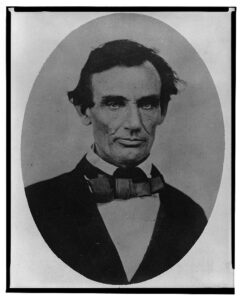
Abraham Lincoln in 1868, two weeks before his final debate with Stephen Douglas. Courtesy of The Library of Congress
Following his 1854 convert to antislavery politics, Abraham Lincoln, had worked tirelessly to advocate against the institution. Privately, he ensured that the new Republican party did not dilute or compromise on their core principle – slavery’s immorality. [8] Publicly, he made strong and eloquent arguments against human bondage. This is especially evident in his 1858 debates with Stephen Douglas. In their first debate in Ottawa, Illinois, Lincoln described slavery as a “monstrous injustice” which violates “the very fundamental principles of civil liberty,” [9] rhetoric that Frederick Douglass surely would have agreed with. However, much to the horror of Douglass, Lincoln’s critiques of slavery in these debates were juxtaposed with very direct racism. In that same speech, Lincoln assured the crowd that he “would never consent to confer the right of voting and of citizenship upon a negro.” [10] He further clarified his opposition to equality in their fourth debate in Charleston, Illinois: “‘I will say that I am not, nor have even been in favor of bringing about in any way the social and political equality of the white and black races [applause]—that I am not nor ever have been in favor of making voters or jurors of negroes, nor of qualifying them to hold office, nor to intermarry with white people.’” [11] Lincoln’s support of discriminatory practices left a bad impression on Frederick Douglass, one which persisted for several years. Because Lincoln did not advocate racial equality, Douglass reasoned, he could not be sincerely opposed to slavery, as the two were so connected in Douglass’s mind. [12] Thus, wrote Douglass as the 1860 election approached, “‘I cannot support Lincoln.’” [13]
Douglass’s skepticism of Lincoln’s motives continued into the Civil War, partially due to Lincoln’s inaction regarding emancipation and dismissal of General Frémont’s military emancipation [14] but also due to Lincoln’s continued public racism, which manifested itself most directly at the President’s August 14, 1862 pro-colonization press conference. There, in front of five Black religious leaders, he claimed that African-Americans and Whites had a “’physical difference’” that brought a “’great disadvantage to us both.’” [15] He then essentially pinned the blame for the Civil War on African-Americans, saying that “‘the institution of Slavery, and the colored race as a basis’” [16] caused the conflict. He ended the meeting (the dialogue of which Lincoln made sure to send to the press) with an appeal to colonization, which he claimed would assist the abolitionist cause. [17] The conference enraged Frederick Douglass, and he spoke out against its racism, claiming blacks and whites could happily coexist. Douglass considered himself an American, and Lincoln’s endorsement of colonization, which Douglass believed to be discriminatory [18], especially infuriated him. Similar to 1860, Douglass viewed the conference as evidence for Lincoln’s racism and thus lack of moral commitment to abolition, and it led him to reason that Lincoln would not emancipate. [19] It must have surprised him when, 39 days later, Lincoln issued the preliminary Emancipation Proclamation.
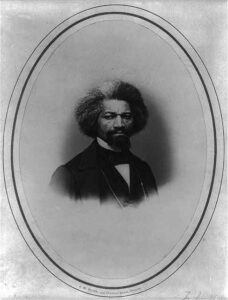
Frederick Douglass. Courtesy of The Library of Congress
Douglass was overjoyed upon the Proclamation’s announcement, which he highly praised and initially considered to be a death sentence for slavery. [20] However, his suspicions of Lincoln’s antislavery insincerity remained, and they again rose to prominence in January of 1863 following Lincoln’s December reveal of his Proclamation of General Amnesty and Reconstruction, a plan for the reintegration of Southern states following the seizure of parts of Louisiana. [21] While the plan contained measures that enforced permanent emancipation, it failed to give African-Americans the franchise, which angered Douglass. He vocally opposed the plan, and argued that it should include “‘the complete, absolute, unqualified enfranchisement of the colored people of the South.’” [22] Lincoln’s failure to grant suffrage to African-Americans was viewed by Douglass as evidence of the President’s lack of commitment to equality. Since he associated discrimination with slavery, this plan must have reignited Douglass’s concerns over Lincoln’s true commitment to abolition, which caused him to question the Emancipation Proclamation itself. The same month he criticized Lincoln’s Reconstruction plan, he attacked the “‘motive and principle’” behind the Emancipation Proclamation – military necessity. [23] He claimed that it was discriminatory, as it allowed slavery to persist in the North. [24] Douglass was previously a staunch supporter of this argument [25], so this reevaluation indicates a return to his previous belief that Lincoln was not morally committed to antislavery. Lincoln’s decision to issue Emancipation Proclamation, Douglass now believed, was guided by military need rather than a true hatred of slavery, and it thus illustrated Lincoln’s tendency to “‘Do evil by choice, right by necessity.’” [26] In reality, Lincoln did the opposite, and had been for years.
Abraham Lincoln was a politician, and all politicians are at some level restricted by the ideologies of their constituents. Thus, he needed to work within the bounds of public approval in order to gain and keep the power needed in order to achieve his antislavery goals. This was a difficult task, as the deeply ingrained prejudices of many Northern voters lessened the appeals of emancipation. Interestingly, many of them – including Stephen Douglas – followed a logic similar to Douglass’s regarding slavery and race. Douglas assumed that Lincoln’s antislavery indicated a support of racial equality, a concept that disgusted many Northerners. [27] Lincoln understood that a belief in equality would limit the scope of his antislavery message, so he separated the issues of slavery and racism, which allowed his argument to survive amidst white supremacist Northern sentiment. [28] To do this, he utilized what Oakes calls “strategic racism,” [29] where he agreed with Northern discrimination, and often concealed his true beliefs regarding equality, in order to shift the focus to slavery. The racist elements of his speeches, unbeknownst to Douglass, were used by Lincoln to advance the cause of antislavery and abolition, making them more agreeable to the bigoted majority.
While Lincoln may have claimed at Charleston to oppose interracial marriage, an analysis of his private views reveals that this did not reflect his true belief. In a personal conversation in 1859, Lincoln said he had “no objection” to intermarriage: “‘If a white man wants to marry a Negro woman, let him do it.’” [30] This dialogue shows that some of Lincoln’s appeal to racism was insincere. Lincoln’s advocacy for colonization, especially the highly publicized August 14 conference, was also likely a political use of racism, specifically to prepare the electorate for the Emancipation Proclamation. [31] Many in the North questioned where freed slaves would fit into society [32], and Lincoln attempted to provide them a sufficiently racist answer through colonization: they would not be joining Northern society at all. [33] Following the Emancipation Proclamation, Lincoln halted his support for colonization, further evidence that he primarily used it as a political tool that did not reflect his moral convictions. [34]
Lincoln’s private writings also indicate that his refusal to enfranchise African-Americans with his Proclamation of General Amnesty and Reconstruction was also a strategic political decision that did not necessarily align with his morals. The Douglass of June 1864, who blasted the Proclamation’s failure to provide the vote, could not have known that Lincoln had written a letter to Michael Hahn, the new governor of Louisiana, that preceding March advocating limited Black enfranchisement. Knowing Hahn had influence on “defin[ing] the elective franchise,” Lincoln suggested, “for your private consideration, whether some of the colored people may not be let in.” Lincoln feared promoting radical policies of equality would lead him to lose the 1864 election, and made sure to remind Hahn that his “suggestion” was “not to the public, but to you alone.” [35]
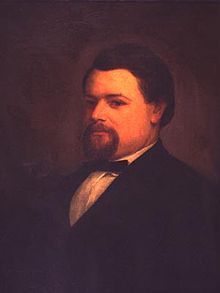
Michael Hahn, governor of Louisiana. Courtesy of Wikipedia

Finally, unbeknownst to Douglass, Lincoln viewed his military justification of emancipation as necessary to win public support, again evidenced by Lincoln’s private writings. In a letter to Salmon Chase, secretary of the treasure, Lincoln explained that, while he felt expanding the Emancipation Proclamation beyond areas of military necessity was “morally right,” it would result in political backlash that would “lose us the elections, and with them, the very cause we seek to advance.” While Lincoln’s hatred to slavery inspired the Proclamation, he viewed its military justification as essential to assuage the Northern public. [36]
Analysis of Lincoln’s private remarks makes his “strategic racism” [37] easy to identify, and paints a convincing picture of his private moral support of abolition and some support of racial equality. Douglass had no access to the private Lincoln, however, and could not possibly know his true morals. He perceived Lincoln how Lincoln wanted moderate Northern whites to perceive him: an opponent of racial equality who emancipated based on legality, not morality. To fully support Lincoln, Douglass would need to see the private, emotional side of Lincoln, a side that shared Douglass’s passionate hatred of slavery. Douglass would encounter this side of Lincoln at his second meeting with the President.
On August 19, 1864, [38] Douglass saw an unexpected sight upon entering Lincoln’s quarters: the President was scared. Lincoln worried, based on pressure from both political parties for a slaveholding compromise, that a loss in the 1864 elections would lead to a proslavery peace that would cause the enslaved to remain in bondage. However, he believed that slaves who had reached the North were permanently freed by the Emancipation Proclamation. [39] Based off this information, he offered Douglass a unique job: “‘I want you to set about devising some means of making slaves acquainted with [the Proclamation], and for bringing them into our lines,’” where they would be permanently free. [40] Essentially, Lincoln, who was “disturbed by the process of slavery’s survival,” [41] wanted Douglass to free as many slaves as possible before the institution was restored. This assignment upended all of Douglass’s negative beliefs regarding Lincoln. It was not designed to help Lincoln politically or even weaken the Confederacy; rather, it was pure, desperate abolition. This was not “right by necessity,” [42] rather, it was right by morality. The fear and desperation Douglass saw in Lincoln made him realize he cared about every slave in America and had “‘a deeper moral conviction against slavery than I had ever seen before in anything spoken or written by him.’” [43] Douglass also noticed an absence of bigotry in Lincoln. He sacrificed his schedule to “have a long talk with my friend Douglass,” which delayed his meeting with the Governor of Connecticut for an hour. Furthermore, Douglass recalled, “‘In [Lincoln’s] company I was never in any way reminded of my humble origin, or of my unpopular color. “[44]
Lincoln’s strong moral opposition to slavery, as well as his ability to treat Douglass with respect, changed Douglass’s view of the President. Before the meeting, Douglass believed Lincoln cared little about slavery and opposed equal rights. After it, Douglass considered Lincoln an antiracist who ardently hated slavery, later eulogizing him as one who took a “‘deep interest’” in the “‘elevation’” of the African-American race. [45] He halted any serious criticism of the President, and, when one of his old private anti-Lincoln letters was leaked to the public, Douglass admitted that its criticisms were unjust. [46] This meeting, and the change in opinion it inspired, transformed Douglass into a staunch supporter of Lincoln, and it is why, at the White House almost a year later, he refused to believe Lincoln would deny his entry.
Douglass’s disbelief of the White House guards, likely inspired by the August 19 meeting, was quickly proven true after Lincoln, noticing the abolitionist, presented him to the crowd as “‘my friend Douglass.’” [47] This was a remarkable display of humility – Douglass, before their meeting, had been a vocal critic of Lincoln – that mirrored Douglass’s own humility when he admitted his views and criticisms of Lincoln were incorrect.
The story of Douglass’s reconciliation with Lincoln teaches an important lesson in American politics, one that should be learned by every politician and reformer: one must be humble enough to allow their views to change, given sufficient evidence. For a long time, Douglass refused to trust Lincoln, a refusal that was understandable: Despite Lincoln’s antislavery accomplishments, Douglass, convinced that abolition and equality must be conjoined, could never fully trust Lincoln. This was a fair premise, as Douglass the radical would always question politicians and never settle for anything less than what he felt his race deserved. The remarkable part of their story is Douglass’s humility: once Douglass realized that Lincoln’s true beliefs aligned with his own, he publicly admitted that he was wrong to criticize Lincoln, and began to support the President. Lincoln was similarly humble by publicly calling Douglass, previously a fierce critic of his politics, his friend. They may have utilized different strategies to combat slavery, but, by attempting to understand and respect one another, they realized that they shared the same goals and forged a genuine friendship. Modern politicians, who rarely admit their own wrongdoings, tend to demonize and refuse to cooperate with their detractors. If Lincoln and Douglass, borrowing from the modern playbook, had been too egotistical to meet a second time, Douglass may not have discovered his common ground with the President. If today’s politicians were able to act with the humility of Lincoln and Douglass, and attempted to understand those they disagreed with, they may, like the two great men, discover they had more in common than they previously thought.
References
- James Oakes, The Radical and the Republican (New York, N.Y.: Norton, 2007), 242
- Oakes, 195
- Oakes, 111
- Oakes, 113
- Oakes, 113
- Oakes, 170
- Oakes, 132
- Oakes, 55; Oakes, 89
- Abraham Lincoln, “First Debate with Stephen A. Douglass, 1858.” In Collected Works of Abraham Lincoln, Volume 2, edited by Roy P. Basler (New Brunswick, N.J.: Rutgers University Press), accessed via The University of Michigan Library, 14
- Lincoln, 11
- James Oakes, The Radical and the Republican (New York, N.Y.: Norton, 2007), 122
- Oakes, 130
- Oakes, 89
- Oakes, 178
- Oakes, 191
- Oakes, 192
- Oakes, 193
- Oakes, 190
- Oakes, 195
- Oakes, 197; Oakes, 201
- Oakes, 221
- Oakes, 223
- Oakes, 224
- Oakes, 224
- Oakes, 224; Oakes, 197
- Oakes, 225
- Oakes, 130
- Oakes, 123
- Oakes, 119
- Oakes, 127
- Michael Vorenberg, “Abraham Lincoln and the Politics of Black Colonization,” Journal of the Abraham Lincoln Association 14, no. 2 (1993): 22-45, accessed August 19th, 2024, URL; James Oakes, The Radical and the Republican (New York, N.Y.: Norton, 2007), 194
- Michael Vorenberg, “Abraham Lincoln and the Politics of Black Colonization,” Journal of the Abraham Lincoln Association 14, no. 2 (1993): 22-45, accessed August 19th, 2024, URL; James Oakes, The Radical and the Republican (New York, N.Y.: Norton, 2007), 179
- James Oakes, The Radical and the Republican (New York, N.Y.: Norton, 2007), 194
- Michael Vorenberg, “Abraham Lincoln and the Politics of Black Colonization,” Journal of the Abraham Lincoln Association 14, no. 2 (1993): 22-45, accessed August 19th, 2024, URL
- Abraham Lincoln, “Letter to Michael Hahn (March 13, 1864).” In Lincoln’s Writings: The Multi-Media Edition, ed. Matthew Pinsker. Accessed August 17, 2024 URL
- Abraham Lincoln, “Letter to Salmon Chase (September 2, 1863)” In Lincoln’s Writings: The Multi-Media Edition, ed. Matthew Pinsker. Accessed August 17, 2024 URL
- Oakes, 119
- “Friday, August 19, 1864.” The Lincoln Log: A Daily Chronology of the Life of Abraham Lincoln. Accessed August 22, 2024. URL
- James Oakes, The Radical and the Republican (New York, N.Y.: Norton, 2007), 230
- Oakes, 231
- Oakes, 232
- Oakes, 225
- Oakes, 232
- Oakes, 232
- Oakes, 245
- Oakes, 233
- Oakes, 242