• Home
  • About
  • How to Contribute
  • Our Correspondents

1

Jun

Fort Pillow Massacre- April 12, 1864

Posted by mckelveb  Published in Civil War (1861-1865), Maps, Rare Books, Recent Scholarship Themes: Battles & Soldiers

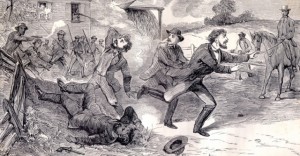
The Confederate Army attacked Fort Pillow in Lauderdale County, Tennessee on April 12, 1864 in a fight that later became known as the Fort Pillow Massacre since the lives of few Union soldiers were spared.  The National Park Service’s website gives a valuable overview of the fight and its commanding figures in its battle summaries section as well as a map that outlines the territory covered under the website’s Civil War Sites Advisory Commission Report Update and Resurvey.  There is also a concise overview of African American Participation in the Civil War located on the website.   Led by Major General Nathan Bedford Forrest, Confederate forces attacked Fort Pillow which was protected by 295 white Tennessee troops and 262 United States Colored Troops.  Union Army Major Lionel F. Booth was killed during the battle and command was subsequently taken over by Major William F. Bradford.  The atrocities committed by the Confederates were best described by The Rebellion Record:

“Then followed a scene of cruelty and murder without parallel in civilized warfare, which needed but the tomahawk and scalping- knife to exceed the worst atrocities over committed by savages.  The rebels commenced an indiscriminate slaughter, neither sparing age nor sex, white nor black, civilian or soldier.  The officers and men seemed to vie with each other in the devilish work; men, women, and even children, wherever found, were deliberately shot down, beaten, and hacked with sabres; some of the children not more than ten years old were forced to stand up and face their murderers while being shot; the sick and the wounded were butchered without mercy, the rebels even entering the hospital building and dragging them out to be shot or killing them as they lay there unable to offer the least resistance.”

Some other sources that may be valuable to further research on Fort Pillow and can be accessed through Google Books are The War of the Rebellion: A Compilation of the Official Records of Union and Confederate Armies as it gives mention of activity at the fort prior to the attack and A History of the Negro Troops in the War of the Rebellion, 1861-1865: Preceded by a Review of the Military Services of Negroes in Ancient and Modern Times which gives an interesting account of the scene at Fort Pillow through the eyes of an African-American soldier.  In terms of modern scholarship, John Cimprich’s Fort Pillow, a Civil War Massacre and Public  Memory provides valuable maps which could help gain a better understanding of the area surrounding the fort.

Post to Twitter Post to Delicious Post to Facebook

no comment

1

Jun

The Capture of Fort Donelson: February 16, 1862

Posted by solnitr  Published in Civil War (1861-1865), Lesson Plans, Places to Visit, Recent Scholarship Themes: Battles & Soldiers, Carlisle & Dickinson

In Ulysses S. Grant ’s memoir, fully available on Google Books, the brigadier general recollected that from February 11 to 16 1862, his men battled extreme winter conditions that alternated between “rain and snow, thawing and freezing” in addition to engaging the 21,000 Confederate troops entrenched at Fort Donelson . Historians Jack Hurst and Kendall Gott  both argue that the Union’s capture of Fort Donelson was a crucial victory as it opened the western theater to Northern troops and supplies.  Hurst’s book, Men of Fire: Grant, Forrest, and the Campaign that Decided the Civil War, and Gott’s analysis, Where the South Lost the War: An Analysis of the Fort Henry-Fort Donelson Campaign, February 1862, are both available in limited preview on Google Books. A key resource for teachers and researchers is the National Park Service’s website on Fort Donelson.  The website includes informational tools for creating lesson plans and field trips  to Fort Donelson, and also features the Fort Donelson National Cemetery’s website , which includes a “Roll of Honor” that lists the known Union soldiers that were reinterred in the cemetery. The National Park website also includes a special section that documents the evolution of the role of African Americans at Fort Donelson, which ranged from slave labor to employment by the U.S. Quartermaster, later reinforced by the Second Confiscation Act of July 1862.  Grant famously demanded “an unconditional and immediate surrender”  from the remaining Confederate general, Simon B. Buckner at Fort Donelson, which resulted in 12,000 to 15,000 prisoners of war including Flavel Clingan Barber , Dickinson College Class of 1850.

Post to Twitter Post to Delicious Post to Facebook

no comment

28

May

Fort Sumter – April 12, 1861

Posted by sailerd  Published in Civil War (1861-1865), Images, Lesson Plans, Letters & Diaries, Places to Visit Themes: Battles & Soldiers

After Confederates fired on Fort Sumter on April 12, 1861, President Abraham Lincoln called for 75,000 volunteers to restore order in South Carolina. This action pushed Upper South states like North Carolina and Virginia to secede and join the Confederacy. The National Park Service’s website on Fort Sumter provides a good place to start and learn more about this event. You can find historic images and modern day pictures as well as information about their education exhibit. Teachers will want to look at the curriculum material and teachers guide. In addition, the National Park Service has put together a variety of documents and essays that provide more background information on Fort Sumter. Another interesting site to check out is Tulane University’s “Crisis at Fort Sumter,” which provides a detailed timeline of what happened regarding Fort Sumter between December 1860 and April 1861. The timeline is divided into several different sections, such as “Dilemmas of Compromise” and “Final Orders.” House Divided also has some material on the Fort Sumter major topic page, including historic images and a bibliography. You will also find links to profiles of several of the individuals who were involved, such as Major Robert Anderson and Secretary of State William Henry Seward. Be sure to check out the “Documents” tab for President Abraham Lincoln’s letters to General Winfield Scott on March 9, 1861 and to Major Robert Anderson on May 1, 1861.

Post to Twitter Post to Delicious Post to Facebook

no comment

26

May

Battle of Antietam

Posted by sailerd  Published in Civil War (1861-1865), Images, Lesson Plans, Places to Visit Themes: Battles & Soldiers

The Battle of Antietam was a key battle during the Civil War that took place on September 17, 1862. After the engagement, President Abraham Lincoln issued the preliminary announcement of the emancipation proclamation. The National Park Service website on Antietam has a number of great resources, including historic photographs by Alexander Gardner, Captain James Hope’s paintings, and a gallery of antique postcards. Teachers can find curriculum materials as well – these include lesson plans, a primary sources packet, worksheets, and scavenger hunts. Visitors can also find a nice timeline, and details on the Army of the Potomac and Army of Northern Virginia. Historyanimated.com, a non-profit educational foundation, has a great battle animation of Antietam. Antietam on the Web also provides a number of great resources, including links to all 315 of the commanders’ After-Action Reports published in the Official Records.

Post to Twitter Post to Delicious Post to Facebook

1 comment

25

May

6th USCT Regiment

Posted by mintzmo  Published in Civil War (1861-1865), Rare Books Themes: Battles & Soldiers

The 6th USCT Regiment was composed mainly of Pennsylvania men, and was organized at Camp William Penn between July and September 1863.  In October, the regiment was assigned to the Army of the James and stationed near Yorktown, Pennsylvania.  The regiment was also part of a plan to release Union prisoners from Belle Isle near Richmond, Virginia.  After a grueling march in early February 1864, the Union forces arrived to find the Confederate forces prepared to meet them, and the battle was lost.  Afterwords, the regiment was posted near Petersburg building earthworks which Confederate forces attacked in May, prompting a successful counterattack in June 1864:

  • “On the 15th of June, the Sixth, together with the Fourth, Fifth, and Twenty second Colored, attacked the left of the rebel earth works in front of Petersburg, and by a determined charge carried the position, resting at midnight within the enemy’s strong fortifications. Early on the morning of the 16th, the colored soldiers of the Army of the James, hailed for the first time, the battle flags of the Army of the Potomac, a division under General Birney, marching in to their relief. The capture of these strong works by the colored troops, was well calculated to inspire respect among the veterans, now rapidly arriving from the Wilderness campaign, for none knew better than they how to appreciate valor. Until near the close of August the Sixth was kept almost constantly on duty in the trenches in front of Petersburg.”

On September 29, 1984, the 6th USCT Regiment fought in the Battle of Chapin’s Farm, which resulted in disastrous casualties for the regiment (of the 367 men entering the battle, 210 were killed, wounded, or missing by the end).  After this battle, the regiment was sent to North Carolina, where it served until the Confederate surrender in April 1865.

The full summary of the 6th USCT Regiment’s actions during the Civil War as well as the complete muster roll is available through Google Books in volume five of Samuel P. Bates, History of Pennsylvania Volunteers, 1861-5 (1871).

Post to Twitter Post to Delicious Post to Facebook

no comment

24

May

“The Pen and the Sword – Perils of Newspaper War Correspondents”

Posted by sailerd  Published in Civil War (1861-1865), Historic Periodicals Themes: Battles & Soldiers, Business & Industry

Correspondents from the New York Herald and other newspapers faced numerous problems in reporting during the Civil War. While “General Grant [was] not afraid of newspaper criticism,” the New York Herald described that others “generals exhibit[ed]…excessive sensitiveness to criticism.” These generals put in place “stringent measures” against newspapers and in some cases even arrested reporters. As the New York Herald explained:

  • “Liable to be cashiered or put to hard labor by our own generals, to be tried and hung as spies by the rebels, or to encounter the dangers without receiving any of the rewards or the honors of the soldier, they exhibit an amount of spirit and nerve which, perhaps, no other class of men are capable of.”

You can read the full editorial here.

Post to Twitter Post to Delicious Post to Facebook

no comment

21

May

Lt. Alonzo Cushing Awarded Medal of Honor

Posted by sailerd  Published in Civil War (1861-1865), Recent News Themes: Battles & Soldiers

Lt. Alonzo Cushing, who died on July 3, 1863 during the Battle of Gettysburg, will be awarded the Meadal of Honor for his actions during that battle. As the Associated Press explains, Lt. Cushing “commanded about 110 men and six cannons” and this “small force…. stood their ground under artillery bombardment as nearly 13,000 Confederate infantrymen waited to advance.” Lt. Cushing served in Battery A, 4th Artillery, United States Army. You can read the full article here. Also,both Alonzo Cushing and his brother (William B. Cushing) have profiles on House Divided.

Post to Twitter Post to Delicious Post to Facebook

1 comment

20

May

43rd USCT Regiment

Posted by mintzmo  Published in Civil War (1861-1865), Rare Books Themes: Battles & Soldiers

After being assembled at Camp William Penn, the 43rd USCT Regiment, composed mainly of Pennsylvania recruits, was assigned in April 1864 to the Ninth Corps of the Army of the Potomac.  Continuing on through Washington, where the African-American regiment “attracted special attention,” the regiment became involved in the Wilderness Campaign in rural Virginia.  On July 30, 1864, at the Battle of the Crater during the Siege of Petersburg, the regiment stepped in after the confusion of the explosion caused the division leading the charge to take cover:

  • “The consternation created by the horrors of the explosion, enabled Ledlie’s Division to advance to, and take shelter in, the crater without serious loss… Finally when the enemy had fully recovered from his fright, had brought supports to cover the threatened point, and was fully prepared to repel further assaults, the Colored Division was ordered to advance.  It was a forlorn hope; but the division moved gallantly forward, in the face of a decimating fire, and passing to the right of the crater, charged towards the crest beyond.  Here so deadly was the fire of infantry and artillery which it met, that it was soon swept back in disorder amongst the debris of the demolished fort, though it succeeded in bringing in some prisoners, Captain Albert D. Wright taking, with his own hands, a rebel battle flag.  Little protection was afforded even here, the enemy soon getting the range, and mercilessly slaughtering the helpless victims huddled together.  A charge made upon them by the enemy, was bloodily repulsed; but it was madness to attempt to hold the position, and almost certain destruction to attempt to go back, every inch of the ground being raked by the enemy’s concentric fire.”

The regiment remained around Petersburg, doing fatigue duty and also fighting in the Battle of Hatcher’s Run in October 1864.  Later, the War Department reassigned the regiment, and it was employed on the front lines in active duty around Richmond (especially at Dutch Gap Canal) until the fall of the Confederate capital. The full summary of the 43rd USCT Regiment’s actions during the Civil War as well as the complete muster roll is available through Google Books in volume five of Samuel P. Bates, History of Pennsylvania Volunteers, 1861-5 (1871).

Post to Twitter Post to Delicious Post to Facebook

no comment

19

May

USCT Liberating Slaves

Posted by sailerd  Published in Civil War (1861-1865), Historic Periodicals, Images Themes: Battles & Soldiers

As United States Colored Troops (USCT) regiments entered southern states, they had the opportunity on numerous occasions to liberate slaves. After one USCT regiment liberated slaves from a plantation in North Carolina, an editorial published in Harpers Weekly on January 23, 1864 noted that they “[left] ‘Ole Massa’ to glory in solitude and secession.” You can read the full article here as well as view the accompanying illustration.

Post to Twitter Post to Delicious Post to Facebook

no comment

18

May

“The Escaped Slave and the Union Soldier”

Posted by sailerd  Published in Civil War (1861-1865), Historic Periodicals, Images Themes: Battles & Soldiers, Slavery & Abolition

This short editorial published in Harper’s Weekly describes two pictures of the same man – one shows him as a fugitive slave from Alabama and the other as a Union soldier. While at first he was a “poor fugitive oppressed with the weariness of two hundred long miles of dusty travel,” Harper’s Weekly explains that he enlisted in the USCT and became a “solder crowned with freedom and honor.” You can read the full editorial here.

See the images described in this editorial in the Slideshow below –

[Show as slideshow]
[View with PicLens]
Harper’s Weekly
Illustration – “The Escaped Slave”
Illustration – “The Escaped Slave in the Union Army”

Post to Twitter Post to Delicious Post to Facebook

no comment
Page 17 of 43« First...10«1516171819»203040...Last »

Search

Categories

  • Period
    • 19th Century (1840-1880)
    • Antebellum (1840-1861)
    • Civil War (1861-1865)
    • Reconstruction (1865-1880)
  • Type
    • General Opinion
    • Historic Periodicals
    • Images
    • Lesson Plans
    • Letters & Diaries
    • Lists
    • Maps
    • Places to Visit
    • Rare Books
    • Recent News
    • Recent Scholarship
    • Video

Themes

  • Battles & Soldiers
  • Business & Industry
  • Carlisle & Dickinson
  • Contests & Elections
  • Crimes & Disasters
  • Education & Culture
  • Laws & Litigation
  • Religion & Philosophy
  • Science & Technology
  • Settlers & Immigrants
  • Slavery & Abolition
  • US & the World
  • Women & Families

Project Links

  • Digital Lincoln
  • HDiv Research Engine
  • House Divided Index
  • L-D Debates Classroom
  • Lincoln in PA
  • PA Grand Review
  • UGRR Classroom
  • Virtual Field Trips
  • William Stoker Exhibit

Administration

  • Log in
  • Entries RSS
  • Comments RSS
  • WordPress.org

Recent Post

  • Teaching Lincoln’s Autobiography in the Common Core
  • Understanding What “Lincoln” Movie Changed About 1865 Peace Talks
  • 15 Examples of Fiction in “Lincoln” Movie Climax
  • Did Abraham Lincoln Really Slap His Son?
  • How the “Lincoln” Movie Reconstructed Thaddeus Stevens
  • How the “Lincoln” Movie Invented Its Lobbying Scenes
  • Art Versus History in the Lincoln Movie Opening
  • Why is February 1st Designated as National Freedom Day?
  • We Got Punked, Lincoln Forgery-Style
  • “Fugitives from Oppression”

Recent Comments

  • Cotton Boll Conspiracy in We Got Punked, Lincoln Forgery-Style
  • Libby Feil in Sterling Family Papers
  • stevetyler in We Got Punked, Lincoln Forgery-Style
  • Mike Kienzler in We Got Punked, Lincoln Forgery-Style
  • Geoff Elliott in We Got Punked, Lincoln Forgery-Style
  • Places to visit in new york in “Abominable Story-Telling” from Northern Newsp…
  • Siege of Petersburg Online - Brett … in “The Barbarians at Harper’s Ferry”
  • Jason in Lincoln's Future Is Digital --Deal With It!
  • historybuff2011 in Recently From the Blogosphere
  • Teach English Abroad in Recently From the Blogosphere

by Wired Studios, Corvette Garage, Jeff Mummert
© Content 2007-2010 by Dickinson College