• Home
  • About
  • How to Contribute
  • Our Correspondents

16

Jun

Battle of Cold Harbor, May 31-June 12, 1864

Posted by mckelveb  Published in Civil War (1861-1865), Images, Letters & Diaries, Maps, Recent Scholarship Themes: Battles & Soldiers

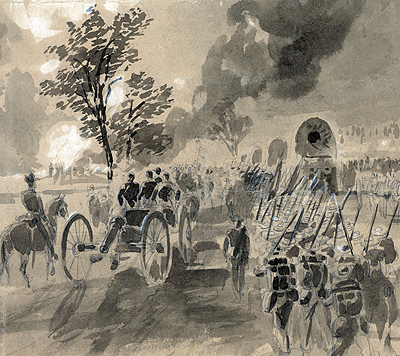
The Battle of Cold Harbor (also known as Second Cold Harbor) took place in Hanover County, Virginia from May 31-June 12, 1864.  As a part of the overland campaign to Richmond of 1864 General Robert E. Lee and the Confederate Army of Northern Virginia defeated Ulysses S. Grant and the Army of the Potomac.  On June 3, the Union II, XVIII, and IX Corps attacked the Confederates at the Bethesda Church-Cold Harbor line and were massacred.  The casualties sustained by the Union Army led Grant to say that  “this charge seemed to revive [Confederate] hopes temporarily.”  The National Park Service’s  website provides an overview of the battle that recounts the day to day activity of the fighting as well as a list of Union and Confederate troops present at the battle.  The National Parks Service’s website also includes a list of suggested readings for teachers and offers interactive travel trunks that are available for loan to classes.  There is a link available that presents visitors with a map  of different stops throughout a tour of the battlefield and gives suggestions for teachers to plan a fieldtrip to the battleground.  The Civil War Preservation Trust ’s website has links to suggested readings, online resources, and battle facts about the events at Cold Harbor.  The site includes a map that details the plan of battle for the Union and Confederate forces.  Another resource that may be interesting to browse is Gordon C. Rhea’s Cold Harbor: Grant and Lee, May 26-June 3, 1864 , available in limited view on Google Books, which gives a rather detailed preview regarding the events of the battle.  Grant commented on the battle in his memoirs:

“I have always regretted that the last assault on Cold Harbor was ever made.  I might say the same thing of the assault of the 22 of May, 1863, at Vicksburg.  At Cold Harbor no advantage was ever gained to compensate for the heavy loss we sustained.  Indeed, the advantages other than those of relative losses, were on the Confederate side.”

Post to Twitter Post to Delicious Post to Facebook

no comment

15

Jun

Battle of Harpers Ferry – September 12–15, 1862

Posted by sailerd  Published in Civil War (1861-1865), Historic Periodicals, Images, Maps Themes: Battles & Soldiers

In October 1909 Union veteran Edward Ripley argued that the Union’s defeat at the Battle of Harpers Ferry (September 15-17, 1862) was a “tragedy:”

“It is not too exaggerated a term to use where 12,000 brave and patriotic Americans, only too willing to serve their country, were bound hand and foot by an incompetent commander and, in spite of indignant protest, handed over to the enemy.”

After General Robert E. Lee invaded Maryland, he sent General Thomas “Stonewall” Jackson to capture the federal arsenal at Harpers Ferry. Col. Dixon S. Miles ordered his forces to retreat into the town in response to Jackson’s attack, which Col. Dixon S. Miles’s response. After the war Union General Julius White argued that “[Col. Miles] had lost all confidence in his ability” and explained that the high ground around Harpers Ferry was critical to defense: “Harper’s Ferry is not defensible by a force inferior to that attacking it, unless the surrounding heights be well fortified, and each of them held by a force sufficient to maintain itself unsupported by others.”
Teachers can learn more about this battle from a short essay and related maps on the National Parks Service website. This site, which also focuses on John Brown’s attack in October 1859, also has a virtual tour and a collection of over 300 images (not all are related to the battle). Anyone planning a visit should check out the detailed information in the “Self Guided” and “Ranger Guided” sections of “Plan a Field Trip” page. Other resources are available from the Library of Congress, including historic maps, photographs, and illustrations by Alfred Waud. In addition, Cornell University’s Making of America has two articles written after the war by Confederate generals John Imboden and John Walker. Union General Julius White, whose article is referenced above, wrote it in response to these Confederate officers’ accounts, which he considered “incomplete.”

Post to Twitter Post to Delicious Post to Facebook

no comment

15

Jun

The Sinking of the CSS Alabama, June 19, 1864

Posted by solnitr  Published in Civil War (1861-1865), Images, Letters & Diaries, Rare Books, Recent News Themes: Battles & Soldiers

On the morning of June 19, 1864, before the naval battle with the USS Kearsarge Captain Raphael Semmes of the CSS Alabama, in an impassioned address, spoke to his crew:

  • “you have been all over the world and it is not too much to say that you have destroyed and driven for protection under neutral flags one half of the enemy’s commerce which at the beginning of the war covered every sea This is an achievement of which you may well be proud and a grateful country will not be unmindful of it The name of your ship has become a household word wherever civilization extends Shall that name be tarnished by defeat The thing is impossible Remember that you are in the English Channel the theatre of so much of the naval glory of our race and that the eyes of all Europe are at this moment upon you The flag that floats over you is that of a young Republic who bids defiance to her enemies whenever and wherever found Show the world that you know how to uphold it.”

Semmes recorded his personal experiences as the captain of CSS Alabama and Sumter in his personal memoir My Adventures Afloat … (1869), available on Google Books. Captain Semmes’ stirring speech did not stop the USS Kearsarge on June 19, 1684 from sinking the Alabama and putting an end to her formidable record. In less than two years the CSS Alabama, a Confederate ship that engaged in commerce raiding by destroying Union merchant ships, sunk 62 ships including the USS Hatteras. The Naval History & Heritage Command, an agency of the Department of the Navy, outlines the history of the ship in an educational website that includes a wide range of resources for classroom use. Students can view images of the battle as published in contemporary newspapers, read excerpts from the official reports of both the Union Captain John Winslow and the Confederate Captain Semmes, or explore recent press releases about the underwater archaeological work being conducted on the wreck since its discovery in 1988 off the coast of France. For other resources, see Historyofwar.org , where they provide maps of the CSS Alabama’s routes and of the battle with the USS Kearsarge.

Post to Twitter Post to Delicious Post to Facebook

no comment

15

Jun

The Battle of Olustee (Ocean Pond): February 20, 1864

Posted by rainwatj  Published in Civil War (1861-1865), Historic Periodicals, Images, Letters & Diaries, Maps, Places to Visit Themes: Battles & Soldiers

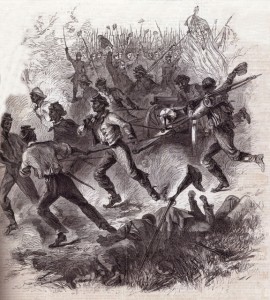
The Battle of Olustee took place on February 20, 1864 in Baker County, Florida where the Union Army under Brigadier General Truman B. Seymour was defeated and forced to retreat back to Jacksonville in the largest battle fought in Florida during the American Civil War.  Under Brigadier General Joseph Finegan, the reinforced Confederate soldiers inflicted massive casualties on Union troops. Estimates on both sides list the total casualties for the Union Army at 1,860, almost 40% of the participating soldiers and 946 Confederate casualties, 20% of their soldiers at Olustee. Seymour’s army was notable for the participation of three colored regiments; the 8th United States Colored Troops, the 35th United States Colored Troops and the 54th Massachusetts Infantry. For more information on these regiments during Olustee, check out portions of J. Matthew Gallman’s chapter in Wars within a War: Controversy and Conflict over the  American Civil War. Other documents of interest related to the Battle of Olustee can be found in volume 35 of the Official Records.

The most extensive collection of resources can be found at the Battle of Olustee site developed by Thomas R. Fasulo which includes primary sources such as official reports, maps, letters, diaries, images, speeches and periodicals. The Olustee Battlefield Historic State Park commemorates the battle and offers visitors a chance to immerse themselves through walking tours of the battlefield and a visitor center with historical information and artifacts. There is an annual reenactment of the battle in February and a Civil War Expo in September that provides visitors an authentic experience of the battle with hands on activities and historical reenactments


Post to Twitter Post to Delicious Post to Facebook

no comment

11

Jun

Camp William Penn

Posted by mckelveb  Published in Civil War (1861-1865), Historic Periodicals Themes: Battles & Soldiers

Camp William Penn in Chelten Hills, Pennsylvania opened as a training ground for African-American troops on June 26, 1863 with about eight men present.  Approximately eleven thousand former slaves and free African-Americans received training here under the leadership of Lieutenant-Colonel Louis Wagner.  Over the course of the war at least eleven regiments formed at Camp William Penn including the 3rd, 6th, 8th, 22nd, 24th, 25th, 32nd, 41st, 43rd, 45th, and 127th Infantries.   Led by Colonel Benjamin C. Tilghman, the 3rd Regiment United States Colored Troops became the first to depart from camp on August 13, 1863.  The soldiers from Camp William Penn went on to fight at Fort Wagner , the Battle of Olustee, and the Battle of New Market Heights (Chaffin’s Farm).  The Civil War Preservation Trust’s website offers an article regarding the participation of USCT Troops in the Battle of New Market Heights and a detailed map of the area.  George Washington Williams said, “The regiments that went from this camp were among the best in the army.  Their officers had been carefully selected and specially trained in military school under competent teachers, and the troops themselves were noted for intelligence, proficiency, and pluck.”  Famous historical figures such as Frederick Douglass and Lucretia Mott lived near the camp or visited the troops occasionally.  Many appeals were made to African- Americans to join the Union Army in newspapers such as The Liberator in Boston:

“Men of color!  We speak to you of your country, of the land where God in his mysterious providence has placed you to work out his inscrutable purposes.  Yet you have been strangers in a land of strangers, and it is now for you to decide whether that land shall be to you and your children more in the future than it has been in the past.  We can make no promises, but we have an abiding faith that the Almighty has not visited us with tribulation in wrath, but in mercy; that you and we, thus tried in the fiery furnace, if true to ourselves and to Him, shall emerge purified and redeemed from the sins and the wrongs of the past.”

Another resource that may be of value for teachers is Donald Scott’s article titled “Camp William Penn’s Black Soldiers in Blue” that gives a concise overview of the troops stationed at the camp as well as an insight into the interaction between the African-American and white soldiers.  Also available in limited view through Google Books is Cheltenham Township which provides some background information and photographs on the area where the camp formed, and includes mention of Camp William Penn and its basic purpose.

Post to Twitter Post to Delicious Post to Facebook

no comment

11

Jun

Battle of Kennesaw Mountain

Posted by sailerd  Published in Civil War (1861-1865), Images, Letters & Diaries, Maps, Places to Visit Themes: Battles & Soldiers

The Battle of Kennesaw Mountain took place on June 27, 1864 in Cobb county, Georgia when General William T. Sherman ordered his forces to attack General Joseph E. Johnston’s Army of Tennessee. Sherman, who was unable to dislodge Johnston’s men, was forced to withdraw  later that day. Some estimates put the number of total casualties at 4,000 (3,000 Union, 1,00 CSA). Teachers will find several resources on the National Park Service’s site, including a short overview of the battle and a Google Earth Tour. This viritual tour shows the location of the Confederate and Union forces on the battlefield as well as hiking and horse trails. The Library of Congress also has some resources , including several sketches by Alfred R. Waud and several maps of General Sherman’s Atlanta Campaign. In addition, Google Books has several interesting accounts of the battle. William Chamberlin, who served with the Ohio Infantry Volunteers, decribed the impact on his regiment:

“Kennesaw Mountain! What soldier who saw it during these days will ever forget its fiery flaming brow? Into how many households does the name bring the gushing tears of sorrow for the loved one whose spark of life went out before that death-dealing giant of Nature? Kennesaw Mountain held Sherman’s army at bay fourteen days during which the loss in killed and wounded was greater than at any previous part of the campaign.”

Lieutenant Warren, who served in the Missouri Confederate Brigade, described the “poor fellows” in the “solid line of blue” whose attack was repulsed. One can find other primary sources related to this battle in Cornell University’s Making of America, including General Johnston’s account and other reports in the Official Records.

Post to Twitter Post to Delicious Post to Facebook

no comment

11

Jun

The 54th Massachusetts

Posted by solnitr  Published in Civil War (1861-1865), Historic Periodicals, Recent Scholarship Themes: Battles & Soldiers

On September 8, 1865, the New York Tribune commented on the unusual amount of fanfare the 54th Massachusetts Volunteer Infantry received on their return to Boston.  The author of the editorial explained the public response reflected the 54th’s status as the first northern regiment of black soldiers and the reputation the regiment earned as being “the one on whose good conduct depended for a long time the success of the whole experiment of arming black citizens in defence of the Republic.”  Edwin Stanton, the Secretary of War, gave Massachusetts governor John A. Andrew permission to begin recruiting black troops on January 26, 1863.  Andrew carefully hired officers to lead the black regiment, including the regiment’s future commander Colonel Robert Gould Shaw, because the 54th was in his opinion “perhaps the most important corps to be organized during the whole war.”  The 54th is well known for their participation in the assault on Fort Wagner, South Carolina on July 18, 1863. The same Tribune article equated the battle’s significance to African-Americans as “Bunker Hill has been for ninety years to the white Yankees.” Captain Luis F. Emilio of Company E published a reflective history of the 54th, A Brave Black Regiment…  (1894), which is partially available on Google Books.  HistoryNet, as mentioned in this previous post, has also published a background article on 54th regimental history that originally appeared in the October 2000 issue of American History magazine.
Members of the 54th who resided in Pennsylvania include:
Sergeant William Harvey Carney of Company C (1840-1908): received a Medal of Honor in 1900 for keeping the regiment’s colors from falling to the ground after Colonel Robert Gould Shaw was shot during the assault on Fort Wagner, the earliest African-American action to be recognized with a Medal of Honor.
Private John Henson of Company C (1843-1880): reassigned to the Ordinance Department of his regiment from November 1864 to February 1865.
continue reading "The 54th Massachusetts"

Post to Twitter Post to Delicious Post to Facebook

no comment

9

Jun

Siege of Port Hudson

Posted by sailerd  Published in Civil War (1861-1865), Images, Lesson Plans, Letters & Diaries, Maps Themes: Battles & Soldiers

The Siege of Port Hudson began in late May 1863 with a series of battles, including one on May 27 that was among the first major engagements that involved African American regiments. After General Franklin Gardner received reports that confirmed the Confederate defeat at Vicksburg, he surrendered his forces to General Nathaniel P. Banks on July 9, 1863. Some estimates put the total number of casualties during the siege at 12,208 (Union 5,000 / CSA 7,208). The National Park Service offers a great lesson plan about Port Hudson through their Teaching with Historic Places program. Teachers will find a short overview of the battle, several accounts from soldiers who participated in the battle, and links to several photographs. Louisiana State University’s Marshall Dunham photograph album also has a number of photographs of Port Hudson. In addition, several battle maps are available from the Library of Congress. Port Hudson may not be that well known, but as General Ulysses S. Grant explained in his Personal Memoirs (1885-1886), the Union’s victory on July 9 was a significant one. “From that day to the close of the rebellion the Mississippi River, from its source to its mouth, remained in the control of the National troops,” as Grant noted. You can also find other documents about this battle in volume 26 of the Official Records. (A list of all the reports starts on page 41).

Post to Twitter Post to Delicious Post to Facebook

no comment

8

Jun

Battle of Fredericksburg

Posted by sailerd  Published in Civil War (1861-1865), Historic Periodicals, Images, Places to Visit Themes: Battles & Soldiers

Battle of Fredericksburg took place in Spotsylvania County, Virginia between December 11–15, 1862 and marked General Ambrose Burnside’s first major campaign as commander of Army of the Potomac. While Burnside’s overall objective was to march on Richmond, Virginia, his army had to first successfully cross the Rappahannock river near Fredericksburg. General Robert E. Lee’s Army of Northern Virginia, however, defeated Burnside’s forces and forced them to retreat. Some estimates put the total number of casualties at 17,929 (Union 13,353, CSA 4,576), which included four generals – two Union (C. Feger Jackson and George Bayard) and two Confederate (Thomas R.R. Cobb and Maxey Gregg). The National Park Service’s website on Fredericksburg provides a nice overview of the battle and offers a number of resources. There are over ten galleries of modern and historic photographs, including “Fredericksburg Sketches” and “Historic Photos.” In addition, the site is creating a virtual tour of the battlefield. Anyone planning on a visit should check out their tour options. The Encyclopedia of Virginia, which is produced by the Virginia Foundation for the Humanities, also provides a nice overview of the battle and links to historic images. Other primary sources about this battle are available at Cornell University’s Making of America, which provides digital access to historical periodicals like The Century. In August 1886, this magazine published five articles by officers who were involved in the battle, including General James Longstreet (HD profile / article) and Union Generals Darius Couch (HD profile / article), William Farrah Smith (HD profile / article), and Rush C. Hawkins (article).Longstreet argued that:

“The battle of Fredericksburg was a great and unprofitable sacrifice of human life made, through the pressure from the rear, against a general who should have known better and who doubtless acted against his judgment. If I had been in General Burnside’s place, I would have asked the President to allow me to resign rather than execute his order to force the passage of the river and march the army against Lee in his stronghold.”

You can also find other documents related to this battle in volume 21 of the Official Records.

Post to Twitter Post to Delicious Post to Facebook

no comment

8

Jun

The First Battle of Bull Run, July 21, 1861

Posted by solnitr  Published in Civil War (1861-1865), Historic Periodicals, Images, Lesson Plans, Maps, Places to Visit Themes: Battles & Soldiers

The artist H. Lovie captured a strange scene on July 21, 1861 in Manassas, Virginia: civilians sitting on a hill overlooking the clash between the Union and Confederate armies.  Lovie’s picture was published in Frank Leslie’s weekly illustrated newspaper, a great visual resource for documenting the Civil War. Both the picnicking residents of Washington DC and Gen. Irvin McDowell’ s troops were unprepared for the hard-fought and bloody Confederate victory at the First Battle of Bull Run (Manassas).  With nearly 5,000 combined casualties, this early battle deflated Northern hopes of a quick and easy war.  General Joseph E. Johnston, commander of the Confederate Armies of the Shenandoah and of the Potomac reflected on their unlikely victory:
  • The admirable character of our troops is incontestably proved by the result of this battle, especially when it is remembered that little more than six thousand men of the Army of the Shenandoah with sixteen guns, and less than two thousand of that of the Potomac with six guns, for full five hours successfully resisted thirty-five thousand U. S. troops with a powerful artillery and superior force of regular cavalry… The unfading honor which they won was dearly bought with the blood of many of our best and bravest.
The Virginia Center for Digital History has created a valuable online resource in their project entitled “Valley of the Shadow” which examines the Civil War through the eyes of Americans on both sides of the conflict. Students can study the 1st Battle at Bull Run by watching 5th Virginia Infantry and 1st Virginia Cavalry’s advance into the battle in the interactive map, read reports by commanding officers, or skim a Pennsylvania newspaper published the weekend following the battle.  The battlefield is preserved by the National Park Service as a national battlefield, and the NPS website provides tools for teachers including lesson plans and field trip outlines.
David Harrison Walton, Dickinson College Class of 1854, fought as part of the Stonewall Brigade during the first Battle at Manassas, as the first commander of the “Shenandoah Sharpshooters”: Company K of the 33rd Virginia.

Post to Twitter Post to Delicious Post to Facebook

1 comment
Page 15 of 43« First...10«1314151617»203040...Last »

Search

Categories

  • Period
    • 19th Century (1840-1880)
    • Antebellum (1840-1861)
    • Civil War (1861-1865)
    • Reconstruction (1865-1880)
  • Type
    • General Opinion
    • Historic Periodicals
    • Images
    • Lesson Plans
    • Letters & Diaries
    • Lists
    • Maps
    • Places to Visit
    • Rare Books
    • Recent News
    • Recent Scholarship
    • Video

Themes

  • Battles & Soldiers
  • Business & Industry
  • Carlisle & Dickinson
  • Contests & Elections
  • Crimes & Disasters
  • Education & Culture
  • Laws & Litigation
  • Religion & Philosophy
  • Science & Technology
  • Settlers & Immigrants
  • Slavery & Abolition
  • US & the World
  • Women & Families

Project Links

  • Digital Lincoln
  • HDiv Research Engine
  • House Divided Index
  • L-D Debates Classroom
  • Lincoln in PA
  • PA Grand Review
  • UGRR Classroom
  • Virtual Field Trips
  • William Stoker Exhibit

Administration

  • Log in
  • Entries RSS
  • Comments RSS
  • WordPress.org

Recent Post

  • Teaching Lincoln’s Autobiography in the Common Core
  • Understanding What “Lincoln” Movie Changed About 1865 Peace Talks
  • 15 Examples of Fiction in “Lincoln” Movie Climax
  • Did Abraham Lincoln Really Slap His Son?
  • How the “Lincoln” Movie Reconstructed Thaddeus Stevens
  • How the “Lincoln” Movie Invented Its Lobbying Scenes
  • Art Versus History in the Lincoln Movie Opening
  • Why is February 1st Designated as National Freedom Day?
  • We Got Punked, Lincoln Forgery-Style
  • “Fugitives from Oppression”

Recent Comments

  • Cotton Boll Conspiracy in We Got Punked, Lincoln Forgery-Style
  • Libby Feil in Sterling Family Papers
  • stevetyler in We Got Punked, Lincoln Forgery-Style
  • Mike Kienzler in We Got Punked, Lincoln Forgery-Style
  • Geoff Elliott in We Got Punked, Lincoln Forgery-Style
  • Places to visit in new york in “Abominable Story-Telling” from Northern Newsp…
  • Siege of Petersburg Online - Brett … in “The Barbarians at Harper’s Ferry”
  • Jason in Lincoln's Future Is Digital --Deal With It!
  • historybuff2011 in Recently From the Blogosphere
  • Teach English Abroad in Recently From the Blogosphere

by Wired Studios, Corvette Garage, Jeff Mummert
© Content 2007-2010 by Dickinson College