 One way to keep up with the 150th anniversary of the Civil War is through the Washington Post’s Civil War twitter account. Every day they tweet details on events that occurred 150 years ago. As Mississippi seceded on January 9, 1861, the Washington Post noted “Miss secedes: ‘Our position is thoroughly identified with the institution of slavery — the greatest material interest of the world.’” Unfortunately the tweets with quotes are not linked to any sources. The Washington Post also has created several other features for the 150th anniversary, including a “Timeline: The Road to Civil War” and a photo gallery on “Washington, D.C.: 1860 and today.” In addition, the Washington Post’s “A House Divided” blog includes posts by Civil War historians on a variety of topics as well as announcements on events related to the 150th anniversary. Harold Holzer, Chandra Manning, and Frank Williams have discussed in recent posts the reasons why President-Elect Abraham Lincoln was silent after his election. Other interesting posts include Gary Gallagher and David Blight on “Could the war have been prevented?” All of the Washington Post’s features on the Civil War are available on this page.
17
Dec
10
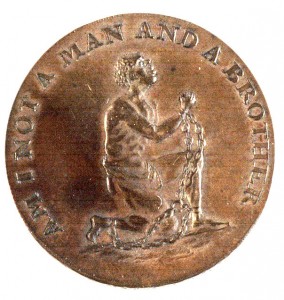
The Gilder Lehrman Institute recently published a new essay by House Divided co-director Matthew Pinsker in their December 2010 issue of History Now. As Pinsker explains in “The Underground Railroad and the Coming of War”:
“The Underground Railroad was a metaphor. Yet many textbooks treat it as an official name for a secret network that once helped escaping slaves. The more literal-minded students end up questioning whether these fixed escape routes were actually under the ground. But the phrase “Underground Railroad” is better understood as a rhetorical device that compared unlike things for the purpose of illustration. In this case, the metaphor described an array of people connected mainly by their intense desire to help other people escape from slavery. Understanding the history of the phrase changes its meaning in profound ways.”
You can read the full essay here. Other essays in this issue include “Lincoln’s Interpretation of the Civil War” by Eric Foner, “The Riddles of ‘Confederate Emancipation’” by Bruce Levine, and “Women and the Home Front: New Civil War Scholarship” by Catherine Clinton. All of the past issues of History Now are available here.
6
Dec
10
 A blog post by Jamie Malanowski in the New York Times’ “Disunion” series featured this political cartoon from House Divided’s image collection. In this entry Malanowski explores how President James Buchanan addresses the secession crisis in his last State of the Union message to Congress in December 1860. “Buchanan at long last waded into the secession crisis…in the manner of a cranky grandfather who has found a pleasant afternoon nap spoiled by a household of fractious children,” as Malanowski describes. (Read the full text of Buchanan’s State of the Union here).This post is part of a new series that, as the New York Times explains, “revisits and reconsiders America’s most perilous period — using contemporary accounts, diaries, images and historical assessments to follow the Civil War as it unfolded.” Other entries include “Two Communiqués, and a Commander’s Dilemma,” “Silencing the Fanatics,” and “An American Thanksgiving, Skewered and Roasted.” You can also learn more about Buchanan from his profile on House Divided or at the James Buchanan Resource Center.
17
Nov
10
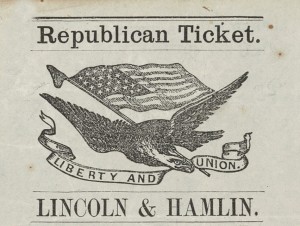
While Abraham Lincoln was elected “by one of the largest voter turnouts in United States history,” historian Phillip Shaw Paludan notes that “the Republican victory was entirely sectional.” Lincoln and Hannibal Hamblin did not receive any votes from the Deep South states. Yet divisions also existed within northern states, including Cumberland County, Pennsylvania. The election results for Carlisle reflected a deep divide in the community – while Republicans won the town (overall votes in Carlisle West Ward / East Ward), Democrats received the most votes overall in Carlisle District (For more details, see election return tables below). As for Cumberland County, Lincoln received 51.5% of the vote in Cumberland County. These results largely correspond with historians’ arguments about urban and rural voting patterns in the 1860 election. While “one might expect to find northern cities to have been stronghold of Republicanism,” David Potter argues that “Lincoln received much less support in the urban North than he did in the rural North.” Republicans received the most votes by far in the rural precincts of Cumberland County and came very close to losing Carlisle. One can see which precinct Lincoln’s party won in the map below — precincts that Republicans won have blank backgrounds. This map was originally published in John Wesley Weigel’s “Free Soil: The Birth of the Republican Party in Cumberland County,” Cumberland County History Journal (Summer 2000). The full article, along with other essays that explore the political history of the Whigs and Democrats in Cumberland County, are available on this post as PDF files.
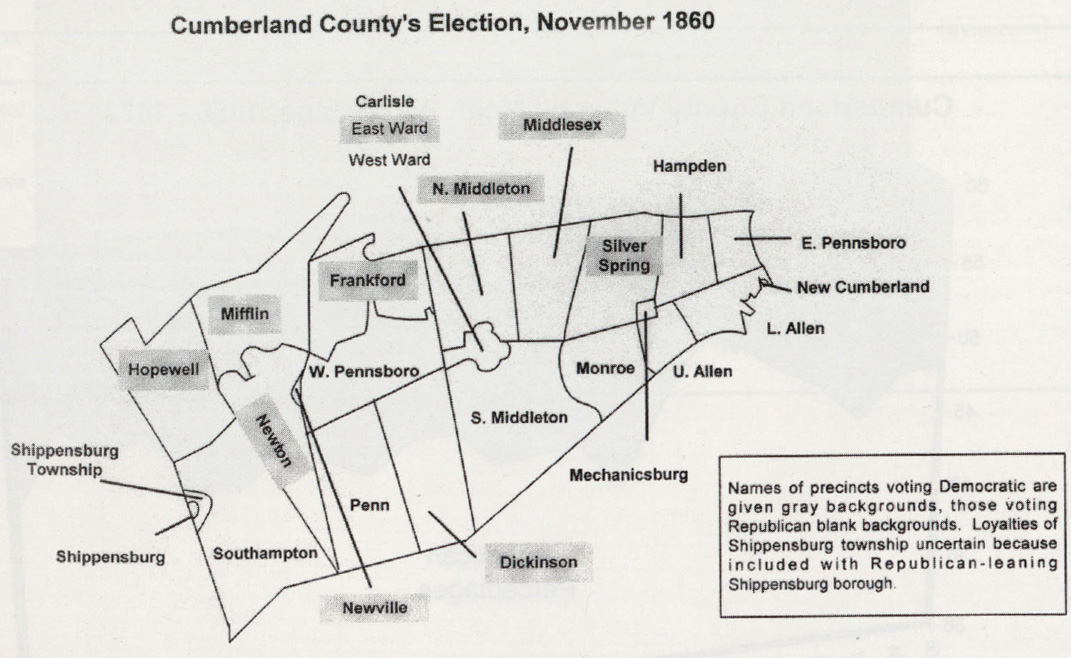
(Click on the map to see larger version)
In addition, you can click the “Continue Reading” link below to see the detailed election returns for Cumberland County, Carlisle District, and Newville District below –
continue reading "Election of 1860 – Cumberland County"
15
Nov
10
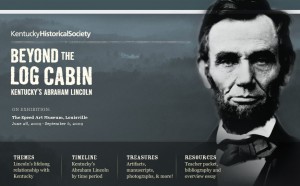 “Beyond the Log Cabin: Kentucky’s Abraham Lincoln” is a great online exhibit created by the Kentucky Historical Society. This interactive site includes manuscripts and artifacts from over 40 repositories nationwide and the content is divided into four overall categories – Themes, Timeline, Treasures, and Resources. Themes include topics such as “Frontier World of Abraham Lincoln,” “Lincoln’s Rise,” “Lincoln and Kentucky at War,” and “Remembering Lincoln: Then and Now.” Each one has a short essay as well as relevant documents, images, and other relevant artifacts. The Timeline section explores Lincoln’s life in Kentucky as well as how the state has commemorated the Sixteenth President after April 1865. The Treasures section allows visitors to explore all of the photographs, manuscripts, and other artifacts in an interactive display. Resources include a Teacher’s guide, a bibliography, and an essay originally published in the Kentucky Historical Society Chronicle.
8
Nov
10
New York Times Features House Divided Image
Published in Antebellum (1840-1861), Images Themes: Contests & Elections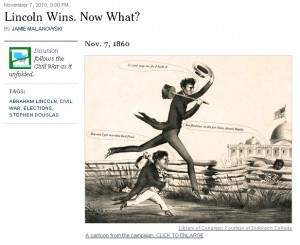 A blog post by Jamie Malanowski in the New York Times’ “Disunion” series featured this political cartoon from House Divided’s image collection. In this entry Malanowski explores Abraham Lincoln’s victory in the 1860 election. Malanowski’s post is part of a new series that, as the New York Times explains, “revisits and reconsiders America’s most perilous period — using contemporary accounts, diaries, images and historical assessments to follow the Civil War as it unfolded.” Other entries include “Hearing the Returns with Mr. Lincoln,” “The Abolitionist’s Epiphany,” “Head-Stompers, Wrench-Swingers and Wide Awakes,” and “A Slave Ship in New York.”
27
Oct
10

As the 150th anniversary of the 1860 election is next week, the House Divided project has just published seven interactive essays at Journal Divided that focus on different aspects of Abraham Lincoln’s campaign. These essays have been adapted with permission from the unedited manuscript of Michael Burlingame’s Abraham Lincoln: A Life (2008). One can read about the origins of the “rail-splitter” image and Lincoln’s efforts to gain support from the Know Nothings. In addition, one will find an overview of the Republican National Convention as well as a detailed look at how Lincoln won the nomination. While Lincoln instructed his allies at the convention to “make no contracts that will bind me,” Burlingame discusses the contradictory claims and evidence about the deals made to secure Lincoln’s nomination. In the final essay Burlingame examines the political conditions that produced a Republican victory in November 1860. As you read the essays, be sure to click through the sidenotes on every page. These contain links to relevant records on House Divided, including those for documents, events, people, place, major topics, and sources. For example, the Gott resolution is mentioned on page 5 of the “Lincoln Know Nothing” essay. If you are unfamiliar with that topic, simply click on the “Events” sidenote to learn more. Each essay also has a video, which you can watch by clicking on the YouTube icon.
8
Oct
10
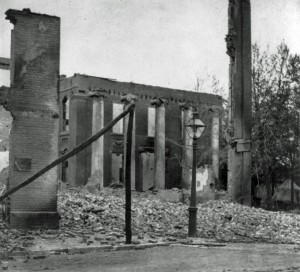
On July 30, 1864 Confederate cavalry under General John McCausland’s command entered Chambersburg, Pennsylvania and demanded that residents pay $500,000 in greenbacks or $100,000 in gold. Confederates planned to use the money to compensate Virginia residents whose homes in the Shenandoah Valley were burned by Union General David Hunter’s troops. After Chambersburg residents refused to pay, General McCausland followed General Jubal Early’s orders and burned the town. (this map shows which sections of the town were burned). General McCausland’s forces left the following day with Union cavalry in pursuit. Philadelphia resident Sidney George Fisher heard about the attack on August 1st. Confederates, as Fisher noted, had “set fire to the place without giving the people time to carry anything away.” Fisher believed that the Confederate actions were the results of the “prolonged” conflict. “The barbarous act shows what a bitter spirit is animating the contest,” as Fisher explained. The Bangor (ME) Whig and Courier, a Republican paper, also expressed “[sympathy for] the suffers at Chambersburg.” Yet “if the atrocious outrage shall awake Pennsylvania to the performance of duties she has long and shamefully neglected in her own defense,” the editor argued that this incident “will in the end prove to be one of the greatest blessings which has been vouchsafed us since the war began.” You can learn more about this attack in Benjamin Schneck’s The Burning of Chambersburg (1864) and Everard H. Smith’s “Chambersburg: Anatomy of a Confederate Reprisal,” American Historical Review (1991).
29
Sep
10
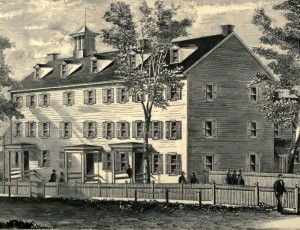 On Thanksgiving day in November 1863 two children whose fathers were killed during the Civil War went to the executive mansion in Harrisburg, Pennsylvania and asked for food. Apparently this experience inspired Governor Andrew Curtin to ask the Pennsylvania legislature to establish an organization to care for orphans of Union soldiers. While legislators did not appropriate the necessary funds, they accepted a private donation to set up an institution whose mission was “the education and maintenance of destitute orphan children of deceased soldiers and sailors.” Children remained in the system until age sixteen – for example, see this list of “Sixteeners” who left in 1877. Schools were set up in communities across the state, including the White Hall School in Camp Hill. Professor David Denlinger opened the school in May 1866, but he quickly ran into trouble. As “the building was…unsuitable for a school of this kind,” James Laughery Paul explains that that “typhoid fever prevailed to an alarming extent in the fall of 1867 and quite a number of deaths occurred.” While the school closed in 1890, alumni returned to Camp Hill in 1926 and dedicated a monument in Willow Park (located at intersection of 24th & Walnut Streets). You can learn more about the organization in James Laughery Paul’s Pennsylvania’s Soldiers’ Orphan Schools (1876), the 1877 and 1909 Annual Report of the Superintendent of Soldiers’ Orphans, and William Henry Egle’s Andrew Gregg Curtin: His Life And Services (1895).
24
Sep
10
Election of 1860 – Ulysses S. Grant
Published in Antebellum (1840-1861), Images, Letters & Diaries Themes: Contests & Elections The Ulysses S. Grant Association at Mississippi State University has digitized all 31 volumes included in the Papers of Ulysses S. Grant. This project also offers a chronology and a nice collection of images. In August 1860 Grant observed that “the Democratic party want a little purifying and nothing will do it so effectually as a defeat.” However, Grant did not want Abraham Lincoln to win in November 1860. “The only thing is dont like to see a Republican beat the [Democratic] party,” as Grant explained. After Lincoln won the election, Grant could not believe that southern Democrats would accept secession. “It is hard to realize that a State or States should commit so suicidal an act as to secede from the Union,” as Grant noted. You can learn more about Grant’s career in William S. McFeely’s Grant: A Biography (1981) and Jean Edward Smith’s Grant (2001). Brooks Simpson focuses on Grant’s role during the Civil War and Reconstruction in Let Us Have Peace: Ulysses S. Grant and the Politics of War and Reconstruction, 1861-1868 (1991).


