The American Antiquarian Society, an independent research library, has provided a digital collection of the Grant-Burr family papers on their website. The letters in this collection were written between the years 1827-1892, and a majority of the correspondence is between Daniel Grant and his wife Caroline Burr Grant. There are over 500 letters, covering a great range of 19th century topics from courtship and childrearing to westward expansion and the Civil War. The collection can be searched by keyword or, perhaps more usefully, can be browsed according to subject. Additionally, the website offers genealogical information and images of the family. All of the transcribed letters are available as a scanned pdf file which is useful for those seeking to use these letters in the classroom. For more information on how to use primary sources in the classroom, teachers may want to refer to this page from the Library of Congress.
21
Oct
09
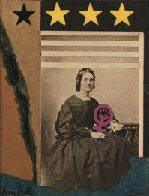
Duke University’s Sallie Bingham Center is an invaluable resource for studying the life and culture of American women. While the collection covers a broad range of topics on all aspects of women’s history, its strength is in Southern women and there are a great deal of resources pertaining specifically to the 19th century. This page features an extensive list of the primary sources that the collection has relating to domestic and social life in the 19th century. Any one of these collections of family correspondence and diary entries could be useful in understanding the cultural and domestic context to the Civil War, but many have not yet been archived online. The resources that can be accessed online now are found here. Other collections relating explicitly to the Civil War period can be found on the subject guides page. Hopefully the Center will continue to provide more digital resources so that the documents in this collection can be accessed by a wider audience.
19
Oct
09
John Brown – Gilder Lehrman Institute
Published in 19th Century (1840-1880), Places to Visit Themes: Battles & Soldiers
The Gilder Lehrman Institute of American History has a new online exhibit on John Brown. The exhibit covers Brown’s life in the 1850s, the attack on Harpers Ferry, and Brown’s legacy. While only a few documents are available right now, they will add more material every month through March 2010.
The Gilder Lehrman Institute has a number of other online exhibits, including one on the Lincoln-Douglas Debates (co-produced by the House Divided Project).
14
Oct
09
Harpers Ferry in November 1860
Published in 19th Century (1840-1880), Images Themes: Battles & Soldiers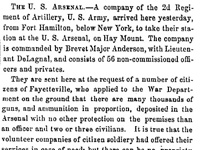 These two reports from November 1860 use John Brown’s raid on Harpers Ferry to argue that a federal arsenal in Fayetteville, North Carolina had to protected, but not in the way that one might expect. Rather than have the local militia continue to provide protection, some Fayetteville residents asked the War Department to send soldiers. While some objected that “local authorities [had] to protect government property at their own expense,” the Fayetteville Observer explained that “the chief inducement…was to negative any idea of a John Brown raid here.” The presence of a US Army company from New York apparently did not cause any serious problems. “So far from irritating the public mind,” the Fayetteville Observer noted that “[their presence] has very materially quieted the public mind here.”
12
Oct
09
The Valley of the Shadow
Published in 19th Century (1840-1880), Images, Letters & Diaries Themes: Carlisle & Dickinson The Valley of the Shadow is a great resource for anyone who wants to learn more about the different ways that northerners and southerners reacted to John Brown’s attack on Harpers Ferry. This digital history project, which from the Virginia Center for Digital History, focuses on two communities – Augusta County, Virginia and Franklin County, Pennsylvania – and their experiences between 1859 – 1870. Besides letters and diary entries, four newspapers are available (two newspapers were published in each county in 1859). The site also provides transcripts for most items as well as enough background information to put the material in context. While everything related to Harpers Ferry is not in a specific section on the site, it is easy to browse to find it.
12
Oct
09
Magazines for Children in the 19th Century
Published in 19th Century (1840-1880), Images, Lesson Plans, Lists Themes: Education & Culture, Women & Families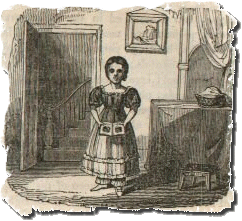 Understanding family life in the 19th century necessitates a look at what was popular with children at the time. This website, put together by an English professor at West Chester University, lists periodicals for children published in the nineteenth century, each of which includes a chronological list of its important articles and links to a digital copy. The magazine Youth’s Companion (which has also been digitized here) covers the most extensive range of topics, with many articles imparting a moral lesson. There are some very interesting articles from the war period to be found as well. Other publications worth noting for their relevance to the circumstances of the Civil War are the Student and Schoolmate, The Slave’s Friend, and The Little Corporal. These primary resources make a great addition to a classroom discussion of the nineteenth century from the perspective of children.
9
Oct
09
Harpers Ferry Sesquicentennial
Published in 19th Century (1840-1880), Lesson Plans, Places to Visit, Recent News Themes: Battles & Soldiers A number of organizations in West Virginia, Pennsylvania, Virginia and Maryland have organized events for the sesquicentennial anniversary of John Brown’s raid on Harpers Ferry. These include the Virginia Historical Society’s exhibit “The Portent: John Brown’s Raid in American Memory,” a reenactment of the march from the Kennedy Farm in Maryland to Harpers Ferry, and an academic symposium. The full list of events schedule for Oct – Dec 2009 is available here. (Registration is required for some of the events). In addition, the Harpers Ferry National Historic Park will commemorate Brown’s raid with a wide range of activities from Oct. 16-18. Check out the full schedule here. Teachers may want to check out this list of resources, which include links to lesson plans.
30
Sep
09
“True and Candid Compositions"
Published in 19th Century (1840-1880), Images, Letters & Diaries Themes: Slavery & Abolition “True and Candid Compositions: The Lives and Writings of Antebellum Students at the University of North Carolina” is an interesting online exhibit from Documenting the American South at UNC-Chapel Hill. The site breaks down this period (1795-1869) into six chapters and each one has essays on key topics and relevant primary sources.
One particularly interesting letter from 1856 shows what can happen to southerners who publicly supported the Republican party. UNC professor Benjamin Hedrick told Hinton Rowan Helper (The Impending Crisis of the South) that “all the means of the worst politicians were at once brought to bear against me,” including “efforts…to excite the students to mob me.” Eventually the UNC Board of Trustees forced him out of the university. As the “trustees [were] nearly all politicians,” Hedrick concluded “they were very willing to sacrifice me to the popular clamor.” (House Divided also has an editorial about this event.) Check out DocSouth’s other digital collections here.
21
Aug
09
Illinois Periodicals Online
Published in 19th Century (1840-1880), Historic Periodicals, Images, Lesson Plans Themes: Settlers & Immigrants The Northern Illinois University offers digital access to a number of different publications. Nine magazines are available from the Illinois Periodicals Online, such as Illinois Heritage (1997-2007). Teachers may want to check out Illinois History Teacher (1994-2009). Each article provides suggestions on how to use it in your classroom. For example, take a look at “Yankees and Southerners Clash in Frontier Illinois” by James E. Davis and the accompanying curriculum materials. In addition, some of the magazines are appropriate for younger readers (see Illinois History).
Teachers can also access the Journal of the Illinois State Historical Society (1979-2006) through NIU’s Illinois Historical Digitization Project.


